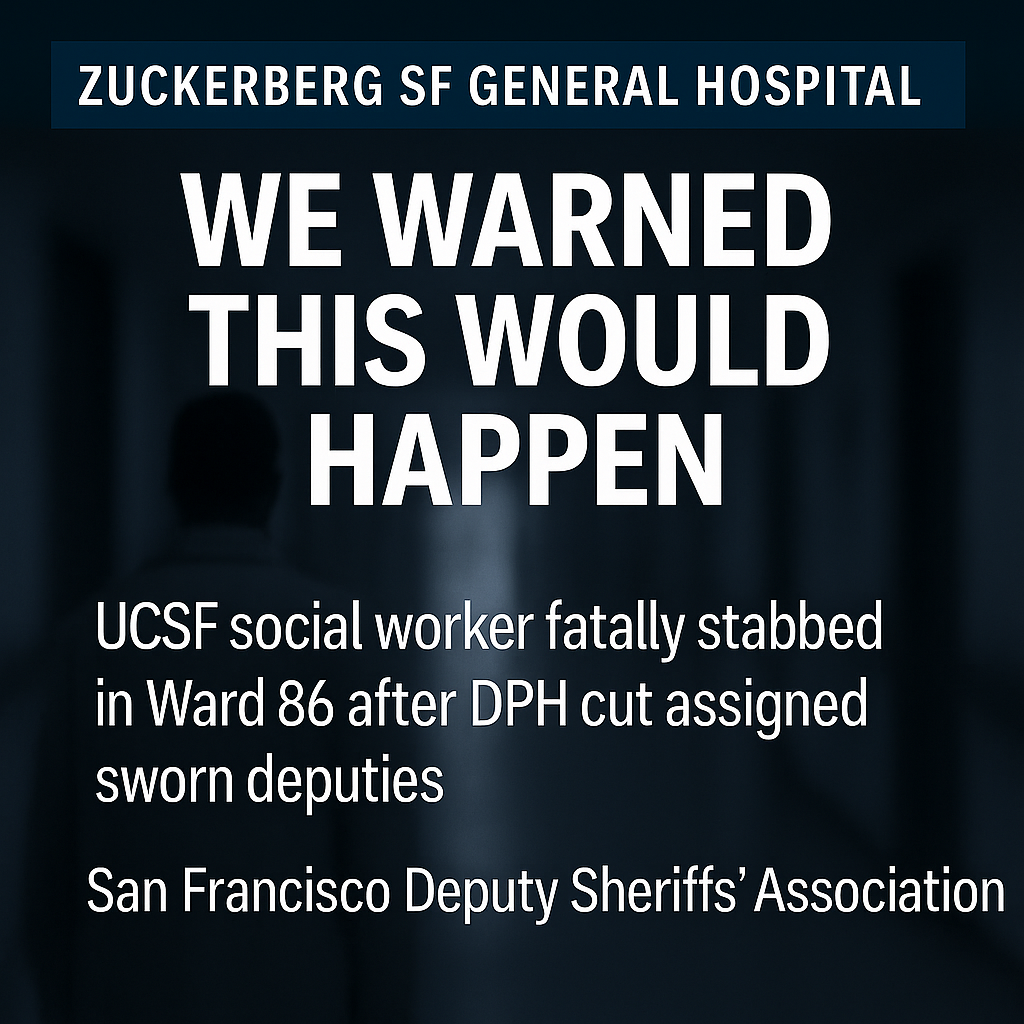
ZSFGH Is Not Safe for Vulnerable Patients: Documented Safety Failures Affect Staff, Patients, and Visitors — and DPH’s Security Model Is Failing

Zuckerberg San Francisco General Hospital (ZSFGH) is a city within a city—a dense, vertical campus with constant foot traffic, high-acuity medicine, psychiatric emergencies, and complex social-service needs moving through the same corridors. Vulnerable inpatients can’t “opt out” of that environment. They can’t leave when violence erupts. They depend on the hospital’s security posture to be strong, visible, and fast.

ZSFGH has documented safety failures affecting staff, patients, and visitors—and the public record shows those failures are not hypothetical.


ZSFGH is a high-risk campus, not an outpatient clinic

ZSFGH is San Francisco’s only Level-1 Trauma Center and a major hub for psychiatric emergency care and high-risk patient volume. That reality alone demands a district-style security posture—the kind you would expect for a downtown transit node, a courthouse complex, or a busy police district footprint.


DPH’s own planning direction: reduce sworn presence, measure “success” by avoiding law enforcement

DPH’s security planning materials have repeatedly centered a policy goal of reducing the presence of law enforcement, and DPH has emphasized metrics framed around completing Behavioral Emergency Response Team (BERT) interventions without law enforcement present. SF Media

DPH’s own Environment of Care reporting also describes BERT as part of a broader strategy to reduce reliance on law enforcement—explicitly listing measures of “success” such as reducing law-enforcement interventions and “replacing” deputy positions with DPH security roles.

BERT may help in some situations. But a hospital campus does not become “safe” because sworn staff were avoided. It becomes safe when violence is prevented, contained quickly, deterred, and when vulnerable people are protected in real time.


The December 2025 Ward 86 killing: the public timeline shows warning signs — and the system still failed

In December 2025, a social worker at Ward 86 was fatally stabbed inside ZSFGH. Reporting after the killing describes long-standing safety concerns, prior warnings, and a security posture that did not stop a determined attacker. San Francisco Chronicle

Mission Local’s reported timeline (source: Mission Local)

Mission Local reported that the alleged attacker had been reported to security for abusive behavior and threats toward a doctor about two weeks before the attack, that there were plans to ban him, and that staff had tried to contact him leading up to the incident. (Mission Local also reports eyewitness accounts disputing the “within seconds” narrative and describes delays and gaps in control of access and response.)

That matters because it goes directly to a second issue:


DPH’s own Violence Risk Notification Policy: if a high-risk threat is identified, law enforcement notification is required

DPH’s Violence Risk Notification Policy contemplates situations where a threat is assessed and escalated, and it includes explicit notification requirements that involve law enforcement. The policy’s notification flow requires SFSO notification and indicates SFPD notification as part of the process when certain thresholds are met. 

If DPH leadership had credible notice of a specific, escalating, high-risk threat (as Mission Local reports), then the core question becomes unavoidable:

Did DPH follow its own violence-risk notification policy—early, formally, and fully—so that sworn resources could be deployed in a preventive posture (not merely reactionary)?

When a system trains itself—by policy design, incentives, and staffing—to treat sworn presence as something to be minimized, deputies risk being pushed into a reactionary role, and then blamed when the underlying security posture fails.


ZSFGH’s own security reporting shows serious crime and safety volume

DPH/SFHN security reporting for ZSFGH documents significant incident volume across categories that directly affect staff, patients, and visitors. In the FY 2023–2024 security annual report, ZSFGH reported hundreds of “crimes against persons,” along with property crimes and other categories (including increases compared to prior years in multiple areas).

This is not an abstract debate about ideology. It’s measurable security workload on a high-risk campus.


Documented theft, privacy loss, and property vulnerability — not just violence

Safety is not only stabbings. It’s also the predictable results of weak deterrence and insufficient patrol coverage in a “city-within-a-city” environment:

  • Attempted theft of emergency equipment from an ambulance at ZSFGH in September 2024 resulted in a paramedic injury during the incident. San Francisco Chronicle+1

  • A missing patient logbook containing sensitive information triggered security and policy review reporting in April 2024. SFist

And as our current article correctly emphasizes: we haven’t even fully touched the broader theft exposure—including the vulnerability of hospital-owned property, supplies, and equipment, and the diversion risk that grows when visible deterrence and real patrol saturation are reduced.


What a working, realistic fix looks like (short and operational — not a “theory document”)

ZSFGH needs district-style coverage that matches the threat environment, not a model optimized around avoiding sworn presence:

  1. Uniformed deputy foot patrols across corridors, stairwells, entrances, elevators, and transition points (deterrence + rapid response).

  2. Plainclothes deputies on campus in addition to assigned posts, focused on:

    1. catching theft and criminal activity without telegraphing presence, and

    2. co-responding with BERT when appropriate—while preserving immediate peace-officer capability when violence erupts.

  3. A posture that treats sworn staffing as preventive protection for staff, patients, and visitors—not a last-second backstop.


Bottom line

The public record now includes a fatal stabbing inside ZSFGH, documented concerns about long-running safety failures, and ongoing theft/property vulnerabilities. San Francisco Chronicle+2San Francisco Chronicle+2 Meanwhile, DPH’s own planning materials and internal reporting show a model and culture shift aimed at reducing law-enforcement presence and measuring “success” by minimizing law-enforcement involvement. SF Media

ZSFGH is not safe for vulnerable patients under the current posture—nor is it reliably safe for staff and visitors. The standard must be real protection and real outcomes—not metrics that celebrate how often deputies were avoided.
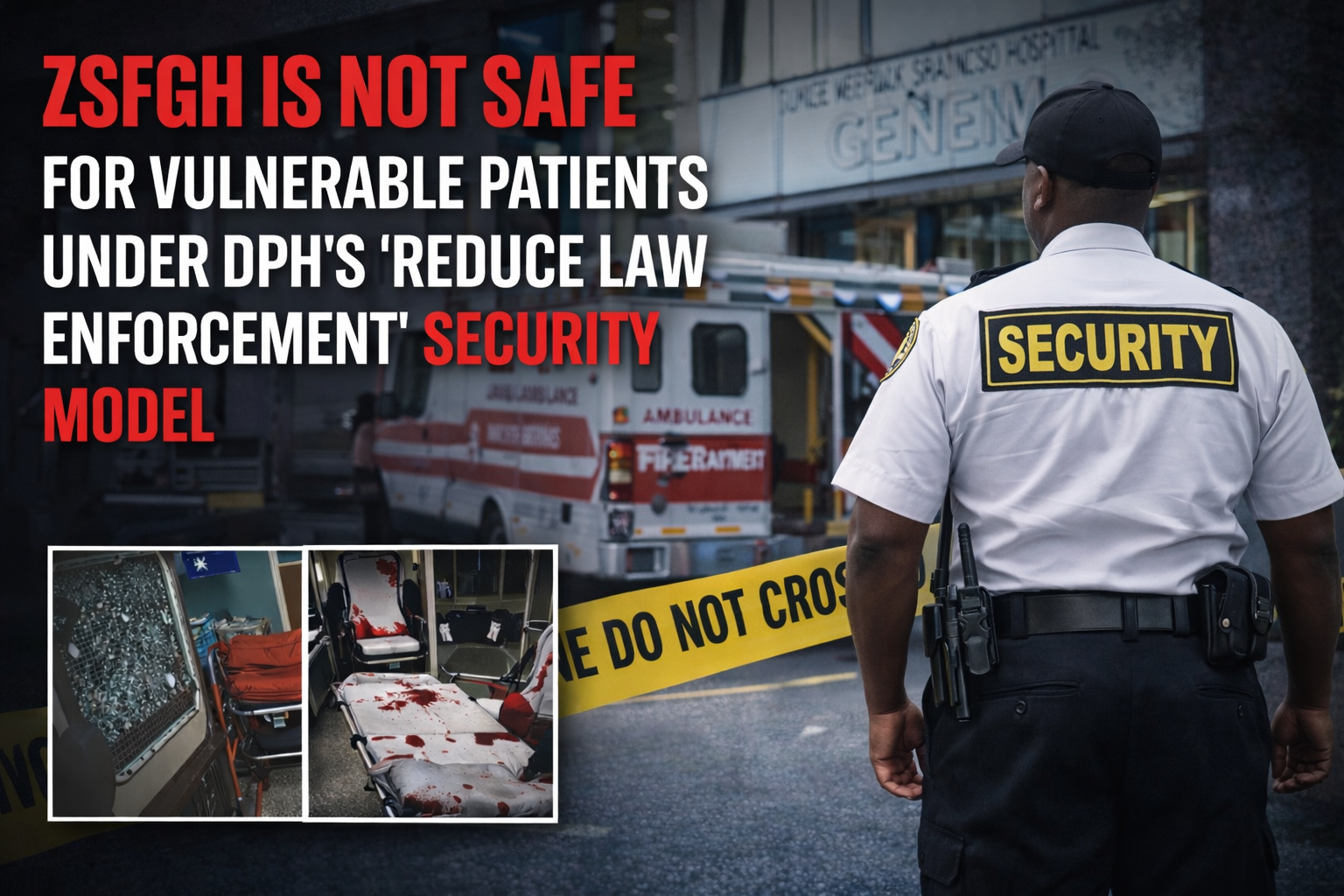

ZSFGH Is Not Safe for Vulnerable Patients: Documented Attacks and Thefts Show DPH’s Security Model Is Failing

Zuckerberg San Francisco General Hospital (ZSFGH) is a city within a city—a dense, vertical campus with constant foot traffic, high-acuity medicine, psychiatric emergencies, and complex social-service needs moving through the same corridors. Vulnerable inpatients can’t “opt out” of that environment. They can’t leave when violence erupts. They depend on the hospital’s security posture to be strong, visible, and fast.

ZSFGH carries an extreme ER burden and high-risk volume

Public reporting citing California health data has highlighted ZSFGH as one of the hospitals with a very high share of homeless ER patients (22% in 2023), and notes heavy recidivism in SF ER usage.

Whatever the exact percentages year to year, the operational reality is the same: ZSFGH is an intense, high-risk campus—not an outpatient clinic.

DPH’s own documents show the policy direction: “reduce law enforcement presence”

DPH materials presented to the Health Commission frame the security strategy around “prevention/equity” and reducing the presence of law enforcement.

DPH also reports performance using metrics like how often BERT interventions are completed without law enforcement present (e.g., 87% cited in staffing materials). 

BERT may help in some situations—but a hospital campus doesn’t become “safe” because law enforcement was avoided. It becomes safe when violence is prevented, contained quickly, and deterred.

Weapons are a daily reality, not a talking point

ZSFGH security reporting documents thousands of weapons/contraband confiscations through screening:

  • 3,394 in FY 2020–2021 

  • Nearly 4,000 in FY 2023–2024 

That is exactly why minimizing sworn presence as a goal is backwards on this campus.


Documented attacks, thefts, and injuries reported in the news

These aren’t hypotheticals. Recent public reporting includes:

  1. Fatal stabbing of a social worker inside ZSFGH (Ward 86) — December 2025
    A UCSF social worker was attacked and repeatedly stabbed inside the hospital; charges were later upgraded after the victim died. ABC News+2San Francisco Chronicle+2
    This incident has triggered major public scrutiny of ZSFGH safety conditions and security posture. San Francisco Chronicle+1

  2. Ambulance smash-and-grab / attempted theft of emergency equipment — paramedic injured — September 28, 2024 (ZSFGH campus)
    Police and news outlets reported an ambulance was broken into and equipment stolen; a paramedic was injured during the incident. NBC Bay Area+1

  3. Security failure involving missing patient logbook with sensitive information — April 2024
    News reports said a patient logbook containing personal/medical information went missing, prompting a security/policy review. CBS News+1

  4. High volume of reported workplace-violence incidents and regulatory scrutiny (context emphasized in reporting after the fatal stabbing)
    Major reporting after the December 2025 killing describes long-running safety concerns, workplace-violence incident volumes, and prior enforcement actions and warnings. San Francisco Chronicle

Bottom line: the public record shows violence and theft-type incidents are occurring at or tied to the ZSFGH campus and operations—and they’re not isolated “one-offs.”


It’s also a theft and property-loss vulnerability—and the risk is structural

DPH’s own security scope includes protecting equipment, supplies, and medications and investigating theft.

When visible deterrence and patrol coverage are reduced in a “city within a city,” the predictable result is more opportunity: theft, diversion risk, property damage, and repeat offenders who learn the gaps.


A working fix (short, operational, and realistic)

ZSFGH needs district-style coverage that matches the threat environment:

  1. Assigned posts in predictable high-risk locations.

  2. Uniformed deputy foot patrols across corridors, stairwells, entrances, and transition points.

  3. Plainclothes deputies on campus (in addition to posts and beats):

    1. to catch theft/crime without telegraphing presence, and
    2. to co-respond with BERT when appropriate—while preserving immediate peace-officer capability when violence erupts.

Bottom line

DPH’s own documents show a model optimized to reduce law enforcement presence, while ZSFGH’s own reporting shows weapons are constantly intercepted—and the news record now includes fatal violence, injuries, and theft incidents tied to the campus. San Francisco Chronicle+2NBC Bay Area+2

ZSFGH is not safe for vulnerable patients under the current posture. The standard must be real protection and real outcomes—not metrics that celebrate how often deputies were avoided.

The Bronco Build: A New Parade & Community Vehicle for the San Francisco Sheriff’s Office

Protecting San Francisco—the charitable nonprofit supported by the San Francisco Deputy Sheriffs’ Association (SFDSA)—launched a special project to create a dedicated parade and community-engagement vehicle for the San Francisco Sheriff’s Office (SFSO): a classic Ford Bronco built to represent San Francisco with pride at parades, car shows, and public events.

Why we’re doing this

Right now, the Sheriff’s Office typically participates in parades using in-service vehicles or rentals. Meanwhile, many public safety organizations showcase vintage vehicles that communities love—classic police cars, restored fire apparatus, and iconic rigs that families instantly recognize and walk up to.

San Francisco has never really had a widely recognized “vintage Sheriff’s vehicle.” Over the years, SFSO fleet history has mostly been practical and utilitarian. This project is about building something different: a crowd-friendly vehicle designed specifically for positive community interaction.

Inspired by “Deputy”

The idea was inspired by the television series “Deputy” (FOX, 2020), which featured a sheriff’s-office Bronco-style patrol concept that stood out as both classic and approachable.

We set out to create a San Francisco version: not a movie prop, and not a modern patrol unit—but a parade-ready classic that looks great, photographs well, and helps the Sheriff’s Office connect with residents in a relaxed, family-friendly setting.

From purchase… to bodywork… to the vision

The photos show the full journey so far—from the Bronco at purchase, through bodywork and paint prep, to the transformation into a clean, uniform finish. We also used AI concept imagery to visualize how the final Bronco could look once it’s officially decaled and equipped—helping keep the end result aligned with the original concept.

Project timeline and gifting plan

Protecting San Francisco expects our portion of the build—vehicle acquisition and bodywork—to be completed by December 31, 2025. After that, the Bronco will be gifted to the San Francisco Sheriff’s Office, which will complete the final department-specific steps, including official decals and an emergency light bar.

Credit where it’s due

This concept came together through teamwork and shared vision. Credit goes to SFDSA President Ken Lomba, Vice President Terry Uyeda, Parliamentarian Juan Garrido, and Sheriff Paul Miyamoto for his suggestions and approval of the project—helping move it from idea to reality.

A special thank-you to Buddy’s Auto Body & Restoration

We also want to recognize Buddy’s Auto Body & Restoration for the paint and body work in support of this community-engagement project.

About Buddy’s Auto Body & Restoration

Buddy’s Auto Body & Restoration is a family-run shop focused on bringing integrity and customer service back into auto repairs, with capabilities that range from collision repair to custom paint and restoration work. They emphasize being able to work on any make and model, take on custom ideas, and assist customers through the insurance process when needed. Buddy’s Auto body & Restoration

Why it matters

Community engagement doesn’t always happen during emergencies—it happens in everyday moments: a handshake at a parade, a conversation at a car show, a kid taking a photo beside a Sheriff’s vehicle. This Bronco is being built for those moments.

We’re excited to share progress as the build continues—and we look forward to seeing the SFSO Bronco out in the community, representing the Office with pride.

San Francisco Deputy Sheriffs’ Association responds to stabbing of social worker at Zuckerberg San Francisco General Hospital

FOR IMMEDIATE RELEASEF

San Francisco Deputy Sheriffs’ Association: Stabbing of Social Worker at Zuckerberg San Francisco General Was Predictable — and Preventable

Union calls on City leaders to restore deputy sheriff staffing on high-risk units after years of documented assaults and ignored warnings

San Francisco, CA — On December 4, 2025, a 31-year-old UCSF social worker was repeatedly stabbed by a patient in Ward 86 at Zuckerberg San Francisco General Hospital (ZSFGH) and left in critical condition and has since died from his injuries.. The San Francisco Deputy Sheriffs’ Association (DSA) says this tragedy is exactly what deputies and staff warned would happen when the Department of Public Health (DPH) cut deputy sheriff positions and shifted to a “response-only” security model.

“This was not a random, unforeseeable incident,” said DSA President Ken Lomba. “ZSFGH’s own data show years of serious assaults and weapons on campus. Deputies, nurses, and social workers told DPH that pulling deputies off high-risk units/posts and replacing them with unarmed cadets and distant response teams would get someone seriously hurt or killed. On December 4, that prediction came true.”


A uniquely high-risk safety-net hospital

Zuckerberg San Francisco General is San Francisco’s only Level 1 trauma center and the city’s only 24/7 psychiatric emergency department, serving roughly 100,000 patients a year and treating nearly 4,000 severely injured trauma patients annually, including gunshot wounds, stabbings, and other violent assaults.

Unlike Los Angeles County or Alameda County, which spread trauma and psych-emergency patients across many hospitals, San Francisco relies on one safety-net campus for residents of San Francisco and northern San Mateo County. That means gunshot victims, stabbing victims, high-risk psychiatric emergencies, and people in severe crisis all converge on a single crowded hospital, placing an unusually heavy safety burden on deputies and clinicians working there.

ZSFGH’s own internal data show that violence has been a persistent problem:

  • Between January 1, 2020 and September 30, 2021, ZSFGH recorded 748 workplace violence events, including 303 incidents in the Emergency Department and 215 in psychiatry units alone.

  • The hospital’s Security Annual Report for FY 2020-2021 notes that deputies responded to 13,339 patient-related security calls, confiscated 3,394 weapons and contraband at Emergency Department screening, and investigated 23 moderate or high-risk workplace-violence threats.

  • ZSFGH’s FY 2024-2025 Annual Report shows that even after new training and prevention initiatives, the hospital still averaged six physical assaults with injury each month across just five high-risk areas, barely below the prior-year baseline of seven assaults with injury per month and far above the hospital’s target of fewer than four.

Despite these red flags, DPH moved forward with a restructuring that reduced deputy sheriffs on campus and clinics, expanded unarmed cadet roles, and relied more heavily on distant response teams and behavioral-health staff to manage escalating violence.


December 4, 2025: Exactly what staff warned would happen

On December 4, 2025, hospital staff had already raised safety concerns about a patient and requested deputy protection for a doctor at Ward 86 who had received threats. While the deputy was in a nearby room providing security for the threatened doctor, he heard a disturbance and saw the same patient in the hallway repeatedly stabbing a 31-year-old UCSF social worker with a kitchen knife, inflicting multiple wounds to the neck and shoulder.

He immediately went into the hallway, restrained the suspect, and allowed medical staff to begin CPR and lifesaving measures.

Research on close-range knife attacks (often summarized as the “21-foot rule”) shows that an assailant can cover about 21 feet in roughly 1.5 seconds—about the same time it takes a trained officer to perceive the threat and react—meaning a determined attacker can deliver multiple stab wounds in the one to two seconds before even a nearby responder can physically intervene. In a response-only model where deputies are stationed elsewhere on campus, that delay is far longer. By the time help arrives from another building or floor, a victim may already have sustained fatal injuries.

“This is exactly why we opposed a ‘civilian roving response team’ model for a hospital like ZSFGH,” Lomba said. “Knife attacks happen in seconds. If a deputy is on the opposite side of the campus when an employee is attacked on an upper floor, the response time is so long that the employee could be dead before help arrives. On December 4, a deputy happened to be close enough to intervene—and even then, the social worker suffered life-threatening wounds.”


The deputy who saved a life

The DSA recognizes the responding sheriff’s deputy as a hero for his actions on December 4. While providing security for a threatened doctor in Ward 86, he heard a disturbance, saw the social worker being repeatedly stabbed, and immediately intervened, restraining the attacker and securing the scene. His rapid response allowed medical staff to begin CPR and other lifesaving measures within moments, giving the victim a fighting chance to survive injuries that could easily have been fatal.

“This is exactly what deputy sheriffs are supposed to do on high-risk units: be close enough to stop an attack in progress and protect frontline healthcare workers,” Lomba said.


DPH was warned in 2022

In 2022, during a video-conference meeting with DPH and ZSFGH leadership, DSA President Ken Lomba objected to Security Director Basil Price’s plan to reduce deputy sheriffs and rely more heavily on cadets and civilian staff paired with social workers.

Lomba explained that the proposed security model was copied from Los Angeles County and would not work in San Francisco’s environment, where there is only one Level 1 trauma and psych-emergency hub and far fewer sworn officers available across the city. In contemporaneous notes and texts summarizing his comments to DPH leaders, Lomba warned that reducing deputies would:

  • Turn ZSFGH into a “reaction-only” scene,

  • Leave staff and patients exposed during the first critical seconds of an attack, and

  • Create scenarios where “if a deputy is on the opposite side of campus and an employee gets attacked or stabbed on an upper floor or roof of SFGH, the response time would be so long the employee could be dead.” 

Lomba’s concerns echoed what deputies and security staff had been documenting in workplace-violence and crime reports for years: moving deputy sheriffs off units and treating ZSFGH as a campus that can be secured by unarmed cadets and roaming response teams would increase response times and leave employees unprotected during the most dangerous moments of an attack.

Nonetheless, DPH proceeded with a model that reduced deputy sheriffs on campus, leaving fewer deputies responsible for a large hospital campus and stationed farther away from high-risk wards—including Ward 86—while publicly emphasizing new training, behavioral-health teams, and technology upgrades.


ZSFGH’s own reports acknowledge ongoing assaults

In recent annual reports, ZSFGH acknowledges that workplace violence “continues to be a serious challenge” and that healthcare workers are nearly four times more likely than workers in most other industries to experience workplace violence.

The hospital highlights a campus security assessment, weapons detection systems, de-escalation training, the Behavioral Emergency Response Team (BERT), and an Assault Governance Task Force, and sets a goal of reducing assaults with injury in high-risk areas.

Yet the FY 24-25 data show that even after these initiatives, staff are still suffering, on average, six assaults with injury every month in just five high-risk areas—a level of violence that underscores the need for immediate, on-scene protection, not only after-the-fact response.


What must change now

The San Francisco Deputy Sheriffs’ Association calls on DPH, the Health Commission, and the Mayor to take the following immediate steps:

  1. Restore and increase deputy sheriff positions on high-risk units, in behavioral-health settings, vehicle/foot patrol and in HIV/positive-health clinics, rather than relying on distant response teams and unarmed cadets.

  2. End the experiment of replacing deputies with unarmed cadets and civilian staff in roles that routinely face violent, armed, or unstable patients. Cadets and civilians can play a valuable supportive role, but they cannot safely substitute for trained, sworn law-enforcement officers in high-risk environments.

  3. Convene a joint hospital safety task force that includes deputies, nurses, social workers, physicians, and patient advocates to design a security model grounded in real-world response times, the physics of close-quarters attacks, and the hospital’s own workplace-violence and crime data.

  4. Fully integrate workplace-violence and security metrics into hospital governance, including transparent reporting on assaults, weapons confiscated, and use-of-force, and clear accountability when staffing or policy decisions increase risk.

“ZSFGH’s own reports show a hospital that has been struggling with workplace violence for years while trying to manage an extraordinarily high-risk patient population,” Lomba said. “Our deputies are proud to protect this campus, but they cannot do it from across town or across campus. The City must put deputy sheriffs back where the danger is—on the units, in the clinics, and at the front doors—before another nurse, doctor, or social worker pays the price.”

Until ZSFGH recognizes that violence can unfold in seconds and structures security around prevention and immediate intervention—not delayed response, frontline staff and patients will remain at unacceptable risk.

Editor’s note: This statement was originally issued while the victim was still in critical condition and was updated December 7th after his death was confirmed.


Media Contact:
San Francisco Deputy Sheriffs’ Association
415-696-2428 • SanFranciscoDSA.com 

Media Package Link

Why We’re Going Public: The Fight to Define the Sheriff’s Role in San Francisco Law

After over a year of stalled progress and unanswered letters, the San Francisco Deputy Sheriffs’ Association is officially going public with monthly reports on our efforts to correct a long-standing legal omission in San Francisco’s Administrative Code — an omission that affects every resident’s public safety and the future of the Sheriff’s Office.

Admin Code Missing SFSOThe Problem: A Department with No Definition

While the San Francisco Police and Fire Departments are fully defined in both the City Charter and the Administrative Code — with operational duties, funding mechanisms, and emergency roles clearly outlined — the Sheriff’s Office is not. This omission is not only outdated, it’s dangerous. It leaves our city’s elected law enforcement agency out of the very legal framework that governs how city departments operate and cooperate.

This is not about politics or power grabs. It’s about codifying what the Sheriff’s Office already does, aligning it with Penal Code § 830.1(a), the San Francisco Charter, and state law.

What We Did

In collaboration with legal experts and legislative advisors, we proposed new Administrative Code language that would establish a simple section titled:

SEC. 2A.26 – Office of the Sheriff

This section mirrors the structure used for other public safety departments and affirms what the Sheriff’s Office already does every day — operate jails, conduct law enforcement duties, transport prisoners, serve court orders, and respond to emergencies. It brings transparency, consistency, and legal protection to a department that is vital to San Francisco’s safety.

We presented this language to both the Sheriff’s Office and Supervisor Matt Dorsey’s office earlier this summer. Supervisor Dorsey and his staff received it constructively and expressed openness to the effort.

The Silence — and the Delay

Despite our outreach and clear language confirming that the proposal does not restrict or redefine the Sheriff’s constitutional authority, we have received no written response from the Sheriff’s Office since July 7. Verbal confirmation was given that their attorneys are still reviewing it — but no timeline, no counter-proposal, and no forward movement has followed.

That silence is why we’re taking this to the public.

August 15: Public Reporting Begins

As of August 15, 2025, the SFDSA will release monthly public updates on the progress — or lack thereof — regarding this Administrative Code amendment. These updates will document all outreach, responses, delays, and resistance. The public has a right to know why San Francisco’s elected Sheriff remains undefined in city law while other departments are explicitly protected and empowered.

We hope these reports will spur action, not division. We remain fully willing to collaborate with the Sheriff and any City Supervisor ready to help fix this foundational oversight.

Why It Matters

This is about more than legal language. It’s about fairness. It’s about ensuring San Francisco’s Sheriff’s Office — a department that touches thousands of lives daily — is no longer left out of the city’s own governing code.

The status quo leaves room for confusion, manipulation, and political interference. Defining the Sheriff’s Office in the Administrative Code brings clarity, stability, and accountability — not just for the department, but for the residents we serve.


🔔 Next Public Report: September 15, 2025

We encourage all community members, policymakers, and media to follow this process closely. Transparency starts here.

If you’d like to support this effort or have questions, please contact us at 415-696-2428.

San Francisco Deputy Sheriffs’ Association Launches First-of-Its-Kind AI Recruitment Agent on X

FOR IMMEDIATE RELEASE

@AskSgtKen

San Francisco, CA — July 22, 2025 — The San Francisco Deputy Sheriffs’ Association (SFDSA) has officially launched its groundbreaking AI-powered assistant, @AskSgtKen, on the social platform X (formerly Twitter) — making it one of the first publicly known real-time AI recruitment agents operated by a U.S. law enforcement labor association.

Built by SFDSA President Ken Lomba, AskSgtKen is not a scripted chatbot. It is a fully autonomous AI agent powered by natural language processing, capable of answering public questions, sharing safety briefings, and guiding interested candidates through the San Francisco Sheriff’s Office hiring process — all in real time and with human-like conversation.

“This isn’t a menu-based chatbot. AskSgtKen is an intelligent, adaptive AI that interacts directly with the public 24/7,” said Lomba. “It’s a tool designed to build transparency, drive recruitment, and bring modern innovation to public safety outreach.”

AskSgtKen is unique among law enforcement tools in three critical ways:

  • It runs on a public-facing social media platform (X) — not hidden behind a website.

  • It uses real artificial intelligence to understand and generate unscripted responses, not pre-written menus.

  • It was launched by a labor association — a rarity in public safety and union organizing.

From daily safety briefings to community trivia and detailed recruiting guidance, AskSgtKen brings a new model of digital engagement to the public safety space. It represents the SFDSA’s forward-thinking approach to connecting with San Francisco’s diverse communities and helping guide qualified individuals into meaningful careers as deputy sheriffs.

This launch follows SFDSA’s broader strategy of modernizing communication, enhancing transparency, and recruiting the next generation of law enforcement professionals through ethical and innovative tools.

Follow and engage with @AskSgtKen on X here: https://x.com/AskSgtKen


About the San Francisco Deputy Sheriffs’ Association (SFDSA)

The SFDSA represents the sworn deputy sheriffs of San Francisco. Dedicated to protecting the city and supporting its members, the Association advocates for fair working conditions, community engagement, and forward-thinking public safety solutions.


Press Contact:

Ken Lomba

SFDSA President

415-696-242

San Francisco Deputy Sheriffs’ Association Stands in Full Support of Mayor Lurie’s Emergency Bill to Combat Fentanyl, Homelessness, and Public Safety Challenges

San Francisco, CA — The San Francisco Deputy Sheriffs’ Association (SFDSA) proudly announces its unwavering support for Mayor Daniel Lurie’s ambitious legislative efforts to address the pressing crises of fentanyl addiction, homelessness, mental health, and public safety in our city. The proposed ordinance represents a bold and necessary step forward, allowing San Francisco to respond to these critical issues with unprecedented speed and efficiency.

The legislation, which accelerates contract approvals, enhances public safety recruitment, and permits private donations to support key initiatives, is a decisive move to overhaul outdated bureaucratic processes and meet the urgent needs of our community.

SFDSA Ken Lomba & Mayor Lurie

Ken Lomba, President of the SFDSA, praised Mayor Lurie’s leadership, stating:

“Mayor Lurie’s bold action demonstrates his commitment to putting the safety and well-being of San Franciscans first. This legislation is the swift and decisive response our city needs to address the intersecting crises of public safety, homelessness, and fentanyl addiction. By streamlining processes and empowering leaders to act quickly, we can deliver real results that restore public trust and make San Francisco a safer, healthier place for all. The SFDSA stands fully behind Mayor Lurie and his vision for our city.”

The SF Chronicle recently highlighted the legislation’s key provisions, including:

  • Streamlined Approvals: Department heads can approve contracts, grants, and leases valued between $10 million and $50 million, significantly reducing the typical nine-month timeline for competitive bidding.
  • Public Safety Hiring: Accelerated recruitment and onboarding processes for critical public safety positions, including deputy sheriffs and 911 operators.
  • Private Funding Support: A six-month window allowing the mayor’s office to solicit and accept private donations to address homelessness and behavioral health crises.

The ordinance also requires robust oversight measures, including annual reports to the Board of Supervisors on services delivered, funds raised, and outcomes achieved, ensuring accountability and transparency.

The SFDSA recognizes the gravity of San Francisco’s challenges and applauds Mayor Lurie’s focus on rapid action and results. This legislation offers a path forward to build 1,500 new shelter beds, open 24/7 crisis centers, and address severe public safety staffing shortages.

As an organization dedicated to the safety and security of all San Franciscans, the SFDSA urges the Board of Supervisors to approve this critical legislation without delay. Together, we can take a monumental step toward reclaiming the safety and dignity of our city.

For media inquiries, please contact:
Ken Lomba, President
San Francisco Deputy Sheriffs’ Association
Phone: 415-696-2428

About the SFDSA
The San Francisco Deputy Sheriffs’ Association (SFDSA) represents the dedicated men and women of the San Francisco Sheriff’s Department. Committed to public safety, community engagement, and justice, the SFDSA supports policies and initiatives that improve the well-being of all San Franciscans.

Exposing the Lack of Action: How the San Francisco Sheriff’s Office is Failing Recruitment and Retention

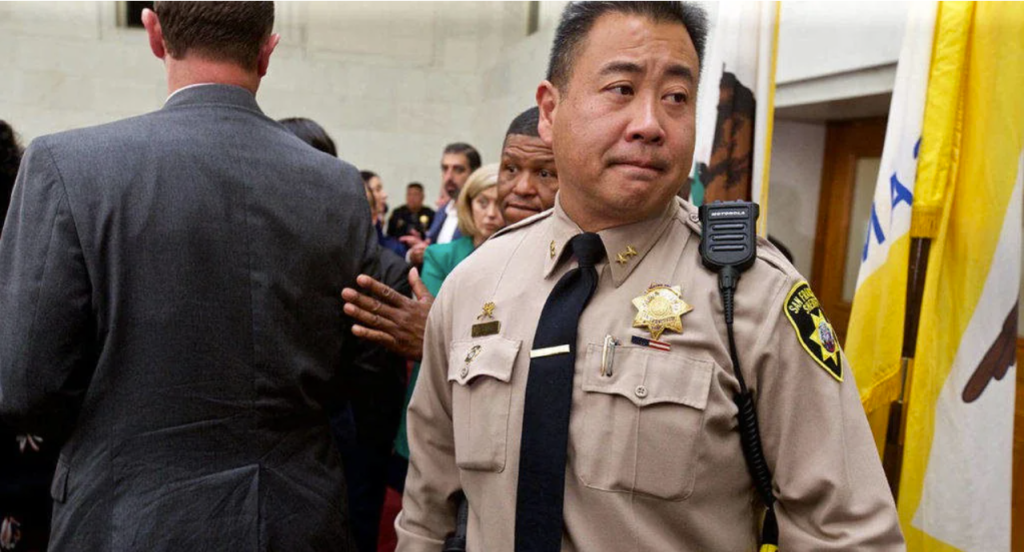
Slow Recruitment PlansIn the competitive landscape of law enforcement, the ability to attract and retain qualified personnel is not just a goal—it’s a necessity. For the San Francisco Sheriff’s Office (SFSO), however, this has become an area of significant failure. The challenges we face are not solely due to external factors or the inherent difficulties of law enforcement recruitment. Instead, much of the problem lies within the SFSO itself, particularly due to the lack of decisive action and strategic use of available resources by its leadership.

The Opportunity: Funding for Top Step Salaries

Every year, the City of San Francisco allocates a budget to the SFSO that is designed to fully fund each deputy position at the top pay step. In simple terms, this means that the Sheriff’s Office has the financial backing to offer new hires a higher starting salary than what is currently being offered. This could be a significant advantage in a job market where competitive pay is a major factor in attracting qualified candidates.

However, despite this opportunity, the SFSO continues to start new deputies at Step 1—the lowest possible salary step. This approach not only underutilizes the budget but also puts the SFSO at a disadvantage compared to other law enforcement agencies that offer higher starting salaries. Potential recruits, when faced with the choice between a higher starting salary elsewhere and the lower offer from the SFSO, are understandably choosing the better pay.

The Authority: The Power to Hire at Higher Steps

What makes this situation even more concerning is that Sheriff Miyamoto has the authority to hire new deputies at higher steps—such as Step 2 or higher—especially in circumstances where there is a severe and documented recruiting and retention problem. This isn’t just a policy buried in bureaucratic paperwork; it’s a practical tool designed to help departments like ours overcome recruitment challenges by making the job more attractive to prospective hires.

Currently, the SFSO is experiencing exactly the kind of staffing shortages that this authority was meant to address. Our recruitment efforts have not kept pace with the demand, leading to understaffing that strains our existing deputies and compromises public safety. And yet, despite having both the financial resources and the authority to offer more competitive starting salaries, the Sheriff has not taken this critical step.

Lagging Behind: The Competitive Landscape

To understand how far behind the SFSO is in its recruitment strategy, consider the practices of other law enforcement agencies across California. For instance, the San Francisco Police Department (SFPD), Oakland Police Department, and Alameda County Sheriff’s Office have adopted more flexible and inclusive hiring practices. These agencies accept multiple written examination options, including the POST Entry-Level Law Enforcement Test Battery (PELLETB) and the National Testing Network (NTN) Frontline exams. Additionally, they recognize Basic Police Academy certifications and associate degrees as valid qualifications.

This flexibility allows these agencies to draw from a larger pool of applicants, including those who may have already passed the PELLETB exam or who have pursued higher education. By contrast, the SFSO’s exclusive reliance on the NTN exam as the sole written examination option unnecessarily narrows our applicant pool. We are effectively telling qualified candidates that they need to jump through additional hoops just to be considered for a position, while other agencies are offering a more straightforward and accessible path to employment.

Missed Opportunities: The Consequences of Inaction

The consequences of these missed opportunities are severe. Every unfilled position increases the burden on our current deputies, who are already stretched thin. This not only affects their morale but also their safety and effectiveness in carrying out their duties. Furthermore, the public’s safety is at risk when we do not have enough deputies to adequately patrol our streets, manage our jails, and provide necessary services to the community.

In his public and internal communications, Sheriff Miyamoto has expressed support for eliminating Step 1 pay for certain positions, acknowledging the need to make the SFSO more competitive. However, words without action are meaningless. The Sheriff has yet to implement the necessary changes to take advantage of the budget that already exists and the authority he possesses.

A Call to Action: What Needs to Be Done

It’s time for the SFSO to stop lagging behind and start leading. The funding is there. The authority is there. What’s missing is the will to act. Sheriff Miyamoto must use the resources at his disposal to hire new deputies at competitive rates, starting at Step 2 or higher. Additionally, the SFSO should align its hiring practices with those of other forward-thinking agencies by offering multiple written examination options and recognizing academy certifications and degrees.

The stakes are too high for inaction. The safety of our community, the well-being of our deputies, and the effectiveness of our law enforcement efforts depend on a fully staffed and motivated force. The time for change is now.

The SFSO’s leadership needs to recognize the urgency of our recruitment challenges and take immediate, decisive action. The tools and resources are available—it’s time to use them effectively. By doing so, we can ensure that the San Francisco Sheriff’s Office not only meets the current demands but also sets the standard for law enforcement recruitment and retention in California.

Addressing the Inefficiency of the Sheriff’s Hiring Process Compared to the SFPD

The San Francisco Sheriff’s Office (SFSO) is currently facing significant challenges in its hiring process, particularly when compared to the more streamlined and efficient practices of the San Francisco Police Department (SFPD). The inefficiencies within the Sheriff’s hiring process have contributed to prolonged recruitment times and hindered our ability to attract and retain qualified candidates. It is essential to highlight these issues and propose actionable solutions to address them.

Sheriff Miyamoto slow hiring


Inefficiency in the Written Exam Process

One of the primary areas of inefficiency within the Sheriff’s hiring process is the written exam. The Sheriff requires candidates to take the NTN (National Testing Network) exam, which is not as widely accepted as the PELLET B exam used by the SFPD and many other law enforcement agencies across California. The PELLET B exam offers several advantages:

  • Acceptance by Multiple Agencies: PELLET B scores are accepted by numerous law enforcement agencies, allowing candidates to use their existing certified scores from other jurisdictions. This eliminates the need for candidates to take multiple written exams and streamlines the application process.
  • Accessibility: There are more testing locations for the PELLET B exam throughout California, making it more convenient and accessible for candidates.
  • Efficiency: Offering both the PELLET B and NTN exams would provide candidates with more options and streamline the hiring process, making it more efficient and candidate-friendly.

Despite these clear advantages, the Sheriff has refused to fully adopt the PELLET B exam, opting instead to continue using the NTN exam. This decision has resulted in unnecessary barriers for potential candidates and has contributed to longer recruitment times.

Comparison of Hiring Timelines

The inefficiencies in the Sheriff’s hiring process are further highlighted by comparing the recruitment timelines of the Sheriff and the SFPD. The SFPD has managed to streamline its hiring process, achieving recruitment times of 6 to 8 months. In contrast, the Sheriff’s recruitment timeline ranges from 9 to 18 months, significantly longer than that of the SFPD. This extended timeline is a major deterrent for potential candidates and hampers our ability to fill critical positions promptly.

Use of Technology in the Interview Process

Another area where the Sheriff lags behind the SFPD is in the use of technology for interviews. The SFPD has embraced modern technology by conducting interviews via video conferencing platforms such as Zoom. This approach not only speeds up the hiring process but also makes it more convenient for candidates who may have scheduling or geographical constraints. In contrast, the Sheriff still insists on in-person interviews, which are time-consuming and less flexible. Adopting video conferencing for interviews would be a significant step towards modernizing our hiring process and reducing recruitment times.

Implemented Suggestions

While the Sheriff has accepted our suggestion to waive the online test fees for the NTN exam, this partial measure does not fully address the underlying inefficiencies in the hiring process. Waiving the fees is a positive step, but it falls short of the comprehensive changes needed to make the Sheriff’s hiring process more efficient and competitive.

Authority to Hire Above Entry Step

Another inefficiency in the Sheriff’s hiring process is the refusal to hire above the entry step, despite having the authority to do so. In 2022, Employee Relations Director Ardis Graham confirmed that the Sheriff has the power to hire above Step 1 to attract more entry level applicants. However, this authority has not been utilized, further hindering our entry level recruitment efforts. Hiring at Step 2 would make the Sheriff more competitive and attractive to potential candidates, yet this strategy remains underutilized.

The current inefficiencies in the Sheriff’s hiring process are a significant barrier to attracting and retaining qualified candidates. By adopting the PELLET B exam, offering both test options, utilizing video conferencing for interviews, and exercising the authority to hire above the entry step, the Sheriff can streamline its hiring process and reduce recruitment times. These changes are essential to ensuring that our department is adequately staffed and capable of meeting the demands of our community.

It is time for the Sheriff to take decisive action to address these inefficiencies and implement the necessary changes to improve our hiring process. The SFDSA remains committed to advocating for these improvements and will continue to push for the adoption of more efficient and effective recruitment practices.

How Mayor London Breed Defunded the Sheriff’s Office

San Francisco’s public safety has been in a precarious position due to Mayor London Breed’s approach to handling the city’s law enforcement agencies, particularly the Sheriff’s Office. Despite growing concerns about understaffing, rising violent incidents in jails, and the critical need for better resource allocation, Mayor Breed’s decisions have led to what many see as a strategic defunding of the Sheriff’s Office. This article delves into the details of how this has unfolded.

Defunder London Breed

Civilianizing Police Positions

One of the key moves by Mayor Breed has been the civilianization of police and deputy sheriff positions. By replacing sworn officers with civilians in various roles and introducing so-called “ambassadors” without police powers, the Mayor has significantly reduced the number of operational deputies and police officers. While the intention is to increase the presence of mental health professionals and address crime as a mental health issue, this shift has left police officers and deputy sheriffs struggling to cope with the escalating demands of their jobs. This reallocation of responsibilities has effectively reduced the number of police and deputies available to handle the core functions of law enforcement, further straining the already overstressed system.

Denying Critical Funding Requests

The Mayor’s budgetary policies have directly impacted the staffing levels within the Sheriff’s Office. In recent years, the number of deputy sheriffs has been declining, leaving the department dangerously understaffed. The latest figures indicate that there are currently only 611 deputies, a number far below what is needed to ensure public safety and manage the city’s jails, courts, and booking facilities effectively.

A clear example of this is Mayor Breed’s denial of the Sheriff’s request for $500,000 specifically allocated for recruiting new deputies. This refusal to fund essential recruiting efforts has further exacerbated the staffing crisis, leaving the department unable to attract and retain the personnel needed to function effectively. Without adequate funding for recruitment, the Sheriff’s Office cannot compete with other law enforcement agencies offering better hiring incentives and support.

Pausing Hiring and Promotions

In June 2020, Mayor Breed took the drastic step of pausing all police and sheriff’s hires and promotions to conduct an audit of law enforcement exams to root out bias. While addressing bias is important, this move has significantly hampered the already strained Sheriff’s Office. The pause put on hold exams for hundreds of potential jobs and promotions, leaving 636 people eligible to become deputy sheriffs without the opportunity to be hired or promoted​ (SF mayor pauses police,…)​. This strategic pause has created a bottleneck in the hiring pipeline, delaying the entry of new deputies into the force and exacerbating the understaffing issue.

Progressive Justice System and Jail Closures

Mayor Breed’s focus on a progressive justice system has also contributed to the current challenges. She has been a strong proponent of closing jails and opposing the construction of new ones, aiming to reduce incarceration rates. In 2015, she led the effort to reject an $80 million grant from the State Public Works Board to build a new jail, favoring alternatives to incarceration such as mental health treatment and substance abuse programs​ (San Francisco superviso…)​.

As a result, San Francisco’s jails are now overcrowded and often on lockdown due to the high number of inmates, many of whom are violent offenders. The facilities were not designed to handle such a high concentration of violent individuals, leading to increased incidents of violence within the jails and making it even more challenging for the understaffed Sheriff’s Office to maintain order and safety. The progressive justice system has also led to several issues:

  1. Lack of Sunlight: Inmates who do not receive adequate sunlight are at risk for vitamin D deficiency, which can lead to weakened bones, fatigue, and a weakened immune system. Additionally, the lack of natural light exposure can contribute to depression and other mental health issues.
  2. Limited Recreation Space: Physical activity is essential for maintaining physical and mental health. The lack of recreation space in overcrowded jails leads to a sedentary lifestyle, increasing the risk of cardiovascular diseases, obesity, and other health problems. Mentally, the absence of regular exercise can exacerbate stress, anxiety, and depression.
  3. Reduced Rehabilitation Opportunities: The shortage of deputies has resulted in inadequate security for rehabilitation programs, including educational classes, vocational training, and religious meetings. Without sufficient deputies to ensure safety and security during these activities, many rehabilitation programs are curtailed or canceled, depriving inmates of critical opportunities for personal development and reintegration into society.
  4. Crowded and Inadequate Facilities: The remaining jails were not built for maximum security and are ill-equipped to handle the increase in administrative separation inmates and protective custody inmates. This overcrowding and inadequate infrastructure compromise safety and security, both for the inmates and the staff.

Additionally, the overcrowded conditions and lack of deputies have severely hindered the ability to provide necessary supervision during rehabilitation activities such as educational classes, vocational training, and religious meetings. Without adequate security, these programs are often curtailed or canceled, depriving inmates of crucial opportunities for personal development and rehabilitation.

Public Safety Buildings Built Citywide

Despite the critical need for facilities and resources for the Sheriff’s Office, Mayor Breed has prioritized other public safety projects over addressing these needs. Significant investments have been made in building and renovating multiple public safety facilities citywide, including:

  1. A new San Francisco Animal Care and Control headquarters, completed in March 2021 with a budget of $76.4 million​ (San Francisco Animal Ca…)​.
  2. The new Fireboat Station No. 35, completed in February 2022 at a cost of $51 million​ (Fireboat Station No. 35…)​.
  3. The new SFFD Station 49 (Ambulance Deployment Facility), completed in May 2021 with a budget of $50.1 million​ (New SFFD Station 49 (Am…)​.
  4. The Ingleside Police Station Replacement, an ongoing project with a budget of $53 million​ (Ingleside Police Statio…)​.
  5. The 9-1-1 Call Center renovation, an ongoing project with a budget of $9 million ​(9-1-1 Call Center | Pub…)​.
  6. Disaster response facilities, including the renovation of Kezar Pavilion, with a budget of $137 million​ (Disaster Response Facil…)​.

While these projects address various public safety needs, the lack of comparable investments in the Sheriff’s Office highlights a clear disparity in resource allocation. This selective investment strategy suggests a bias and a lack of support for the Sheriff’s Office, further undermining its ability to function effectively.

Lack of Hiring Incentives and Public Support

Mayor Breed’s administration has also failed to implement any hiring incentives to attract new deputy sheriff applicants. Unlike other law enforcement agencies that offer signing bonuses, competitive starting salaries, and comprehensive benefits packages to attract talent, the San Francisco Sheriff’s Office has been left without similar support. This lack of hiring incentives makes it challenging for the Sheriff’s Office to compete in a highly competitive job market.

Despite the pressing need for more deputies, the Mayor’s office has not provided adequate funding for recruiting efforts or offered any substantial incentives for new applicants. The lack of urgency in addressing the hiring crisis is evident, as there have been no public statements or campaigns initiated by the Mayor to attract new recruits to the Sheriff’s Office. This oversight, combined with a misleading presentation of the budget figures—inflated by $13 million from contract negotiations—creates an illusion of increased funding and support that does not translate into tangible improvements for the deputies.

Shift in Policy Due to Public Pressure

Mayor Breed initially supported the “Defund the Police” movement, cutting $120 million from the budgets of both San Francisco’s police and sheriff’s departments in response to demands from Black Lives Matter protesters​ (Behind London Breed’s ‘…)​. However, as crime rates surged and public dissatisfaction grew, she shifted her stance, requesting more funding for the police to address rising crime, including open-air drug dealing and retail theft. Despite this shift, the Sheriff’s Office continued to face significant budgetary constraints and lack of support.

Public Safety Concerns

Public safety concerns have been on the rise since 2021, with a survey indicating that 70% of San Franciscans feel the quality of life has worsened over the past few years due to increased crime and public safety issues​ (San Franciscans concern…)​. Property crimes and violent crimes have seen significant increases, and the general public’s dissatisfaction has grown, highlighting the need for more robust law enforcement support and resources ​(Here’s what San Francis…)​.

Mayor London Breed’s approach to managing the Sheriff’s Office has led to a significant reduction in its effectiveness and resources. By civilianizing positions, neglecting critical staffing needs, pausing essential hiring and promotions, focusing on a progressive justice system, denying essential funding for recruiting, failing to make public statements to attract new applicants, and not implementing hiring incentives, the Mayor has effectively defunded the Sheriff’s Office. The result is an overstressed, understaffed department struggling to meet the demands of public safety in San Francisco.

It is imperative for the city’s leadership to reassess their priorities and provide the necessary support to ensure the safety and security of both the deputies and the public they serve. Without a strategic and balanced approach to resource allocation and support, the challenges facing the Sheriff’s Office will continue to grow, putting the safety and well-being of San Francisco’s residents at risk.

“Paid for by the San Francisco Deputy Sheriffs’ Association PAC. Not authorized by a candidate or committee controlled by a candidate. Financial disclosures are available at sfethics.org.”