
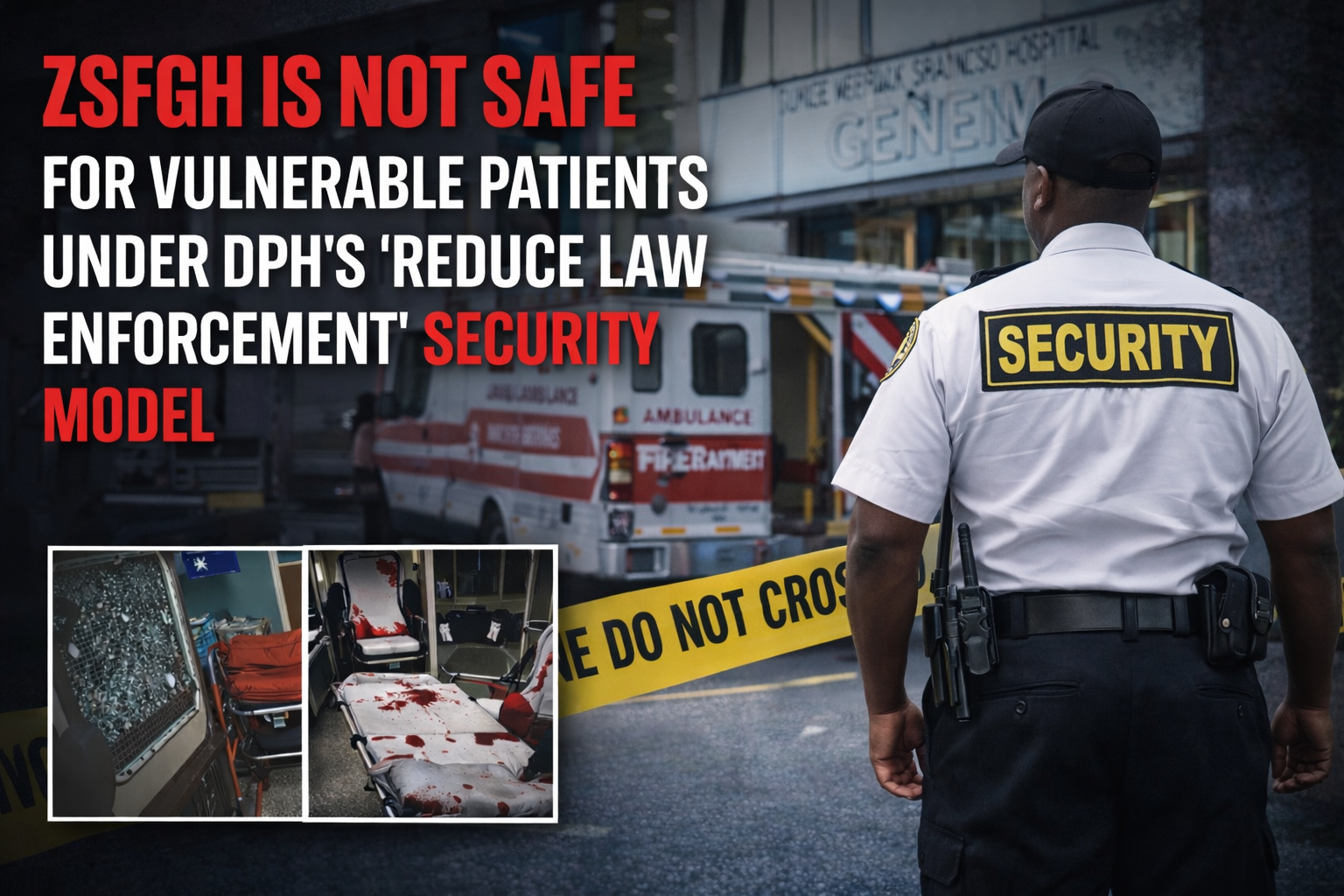
 Zuckerberg San Francisco General Hospital (ZSFGH) is a city within a city—a dense, vertical campus with constant foot traffic, high-acuity medicine, psychiatric emergencies, and complex social-service needs moving through the same corridors. Vulnerable inpatients can’t “opt out” of that environment. They can’t leave when violence erupts. They depend on the hospital’s security posture to be strong, visible, and fast.
ZSFGH carries an extreme ER burden and high-risk volume
Public reporting citing California health data has highlighted ZSFGH as one of the hospitals with a very high share of homeless ER patients (22% in 2023), and notes heavy recidivism in SF ER usage.
Whatever the exact percentages year to year, the operational reality is the same: ZSFGH is an intense, high-risk campus—not an outpatient clinic.
DPH’s own documents show the policy direction: “reduce law enforcement presence”
DPH materials presented to the Health Commission frame the security strategy around “prevention/equity” and reducing the presence of law enforcement.
DPH also reports performance using metrics like how often BERT interventions are completed without law enforcement present (e.g., 87% cited in staffing materials).
BERT may help in some situations—but a hospital campus doesn’t become “safe” because law enforcement was avoided. It becomes safe when violence is prevented, contained quickly, and deterred.
Weapons are a daily reality, not a talking point
ZSFGH security reporting documents thousands of weapons/contraband confiscations through screening:
-
3,394 in FY 2020–2021
-
Nearly 4,000 in FY 2023–2024
That is exactly why minimizing sworn presence as a goal is backwards on this campus.
Documented attacks, thefts, and injuries reported in the news
These aren’t hypotheticals. Recent public reporting includes:
-
Fatal stabbing of a social worker inside ZSFGH (Ward 86) — December 2025
A UCSF social worker was attacked and repeatedly stabbed inside the hospital; charges were later upgraded after the victim died. ABC News+2San Francisco Chronicle+2
This incident has triggered major public scrutiny of ZSFGH safety conditions and security posture. San Francisco Chronicle+1 -
Ambulance smash-and-grab / attempted theft of emergency equipment — paramedic injured — September 28, 2024 (ZSFGH campus)
Police and news outlets reported an ambulance was broken into and equipment stolen; a paramedic was injured during the incident. NBC Bay Area+1 -
Security failure involving missing patient logbook with sensitive information — April 2024
News reports said a patient logbook containing personal/medical information went missing, prompting a security/policy review. CBS News+1 -
High volume of reported workplace-violence incidents and regulatory scrutiny (context emphasized in reporting after the fatal stabbing)
Major reporting after the December 2025 killing describes long-running safety concerns, workplace-violence incident volumes, and prior enforcement actions and warnings. San Francisco Chronicle
Bottom line: the public record shows violence and theft-type incidents are occurring at or tied to the ZSFGH campus and operations—and they’re not isolated “one-offs.”
It’s also a theft and property-loss vulnerability—and the risk is structural
DPH’s own security scope includes protecting equipment, supplies, and medications and investigating theft.
When visible deterrence and patrol coverage are reduced in a “city within a city,” the predictable result is more opportunity: theft, diversion risk, property damage, and repeat offenders who learn the gaps.
A working fix (short, operational, and realistic)
ZSFGH needs district-style coverage that matches the threat environment:
-
Assigned posts in predictable high-risk locations.
-
Uniformed deputy foot patrols across corridors, stairwells, entrances, and transition points.
-
Plainclothes deputies on campus (in addition to posts and beats):
- to catch theft/crime without telegraphing presence, and
- to co-respond with BERT when appropriate—while preserving immediate peace-officer capability when violence erupts.
Bottom line
DPH’s own documents show a model optimized to reduce law enforcement presence, while ZSFGH’s own reporting shows weapons are constantly intercepted—and the news record now includes fatal violence, injuries, and theft incidents tied to the campus. San Francisco Chronicle+2NBC Bay Area+2
ZSFGH is not safe for vulnerable patients under the current posture. The standard must be real protection and real outcomes—not metrics that celebrate how often deputies were avoided.