
Deputy’s Rapid Response at ZSFGH Likely Prevented Mass Casualty Stabbing — But Security Plan Still Keeps Deputies Out of Most Crises

FOR IMMEDIATE RELEASE

Deputy’s Rapid Response at ZSFGH Likely Prevented Mass Casualty Stabbing — But Security Plan Still Keeps Deputies Out of Most Crises

Deputy Sheriffs say DPH’s BERT model minimizes law-enforcement presence and relies on unarmed security in a vertical city of high-risk patients

Deputy Saves ZSFGH Ward 86 from Mass StabbingSan Francisco, CA — The San Francisco Deputy Sheriffs’ Association (SFDSA) is calling attention to the heroic actions of a Sheriff’s deputy at Zuckerberg San Francisco General Hospital (ZSFGH) and renewing its warning that the hospital’s current security model is designed to keep deputies out of most violent incidents while relying on unarmed security and clinical teams.

On December 4, 2025, a stabbing in Ward 86, ZSFGH’s HIV clinic, left UCSF social worker Alberto Rangel with multiple stab wounds. Despite rapid intervention and lifesaving efforts, Mr. Rangel later died from his injuries.

SFDSA President Ken Lomba says that while the deputy could not undo the initial wounds, his rapid intervention almost certainly prevented additional victims.

“What people aren’t being told is that our deputy didn’t just confront one dangerous situation — he likely prevented a mass-casualty stabbing inside that clinic,” Lomba said. “Ward 86 is a high-volume HIV clinic. If the assailant had been able to move freely down the hallway, we could be talking about multiple staff and patients stabbed. The only reason that didn’t happen is because a deputy was close enough to intervene within seconds.”


Unarmed security at the entrance, no fixed deputy post in the 80/90 complex

Under ZSFGH’s current security model, Building 80 – which houses the Ward 86 HIV clinic on the 6th floor – is part of the connected 80/90 complex, with its main public entrance on 22nd Street. According to our union members assigned to ZSFGH, that entrance is staffed by an unarmed private security guard seated at a desk, and DPH relies on additional private security guards who patrol the building’s interior. There is no fixed Sheriff’s deputy post in Building 80.

SFDSA later discovered, through its staffing records, that Building 80 previously had a Sheriff’s cadet post, but DPH eliminated that post in July 2025, leaving only unarmed private security at the public entrance and in the hallways.

In the connected Building 90, ZSFGH operates Ward 93, an Opiate Treatment Outpatient Program (OTOP) methadone clinic on the third floor. Public information lists Ward 93 as a methadone clinic serving adults with substance-use disorders, and our union members report that DPH assigns a private armed security guard inside Unit 93 who is not permitted to leave that unit. That means the one armed security presence in the 80/90 complex is effectively locked to a single clinic, while the rest of the building — including the path to Ward 86 — is covered only by unarmed guards and a greatly reduced number of deputies.

On December 4, a stabbing occurred in the 6th-floor Ward 86 hallway, where UCSF social worker Alberto Rangel was repeatedly stabbed and left in critical condition. An individual was later arrested on suspicion of carrying out the stabbing. Based on information from our members, the individual possibly moved past the unarmed security presence at the 22nd Street entrance and through the 80/90 complex to reach the 6th floor.

The only sworn law-enforcement officer in Building 80 at that time was a Sheriff’s deputy temporarily assigned there solely because DPH had requested protection for a doctor who had previously reported threats from the same individual. When the stabbing began in another area in a hallway, that deputy responded, intervened to stop the attack, helped secure the individual, and allowed medical staff to begin lifesaving care.

“This was not a building with a strong law-enforcement presence,” Lomba said. “It was an unarmed guard at the lobby desk, a handful of roving security guards, no fixed deputy post, and a deputy in Ward 86 only because a doctor had already been threatened. In the end, the only person who physically restrained the suspect and stopped the stabbing was a sworn deputy sheriff.”


A missed opportunity at City Clinic and delayed law-enforcement notification

San Francisco City Clinic, located at 356 7th Street in SoMa, is a DPH sexual-health clinic that does not have any assigned Sheriff’s deputy post. According to public news reports, on the same day as the Ward 86 killing, hours before the stabbing, the same individual went to City Clinic looking for a specific doctor he had been threatening. A clinic director hid the doctor, told the individual the doctor was not there, and then heard the individual say he would go to Ward 86 at ZSFGH to find that doctor later that day. The clinic and the hospital are roughly two miles apart, yet there is no public indication in those reports that either SFPD or the Sheriff’s Office was contacted at that point so law enforcement could attempt to locate or intercept the individual before he reached Ward 86.

Under DPH’s own Threat Management policy, multiple threats combined with a stated plan to go to a specific location to find a targeted provider appear to meet the definition of a “High Risk” case—the very category where the policy warns of imminent danger of serious injury or death and directs staff to notify both SFSD and SFPD. SFDSA is therefore asking DPH to explain why law enforcement was not called from City Clinic when staff had both credible threats and advance notice of the individual’s stated destination, and why the Sheriff’s Office was only brought in shortly before the attack instead of at the earliest warning.


Unanswered questions about DPH’s own threat policy

Through a public-records request under the California Public Records Act (CPRA), SFDSA’s counsel obtained DPH’s Threat Management flowchart, which outlines how threats are supposed to be classified and handled. According to that document, cases are classified as “High Risk” when there are multiple threats of violence and evidence of a violent plan directed at a specific person or location. In those situations, the policy says there is a high probability of imminent danger of injury or death, and the response should include contacting both the Sheriff’s Office and SFPD.

Public news reports about this case describe an individual who threatened staff over a period of time, went to San Francisco City Clinic looking for a specific doctor, told the clinic director he would go to Ward 86 at ZSFGH to find that doctor, and then later allegedly carried out a stabbing in Ward 86. Taken together, those facts appear to fit the very “High Risk” scenario DPH’s own Threat Management policy describes: multiple threats combined with a clear plan to seek out a targeted provider at a specific location.

DPH’s Threat Management flowchart, as produced to SFDSA, states that when a situation is classified as “High Risk,” both the Sheriff’s Office and SFPD should be notified. In this case, a doctor at Ward 86 had already reported threats from the same individual, and DPH specifically requested that a Sheriff’s deputy be assigned to protect that doctor on the day of the stabbing.

SFDSA is calling on DPH and its security leadership to answer two basic questions:

  1. How was this case formally classified under DPH’s Threat Management policy — Low, Medium, or High Risk?

  2. If it was treated as High Risk, were both SFSD and SFPD notified in accordance with that policy — and if not, why not?

“DPH’s own document, which we obtained through a CPRA request, says multiple threats plus a violent plan aimed at a specific person equals High Risk and should trigger calls to both the Sheriff’s Office and SFPD,” Lomba said. “The publicly reported facts about this case look exactly like that scenario. The public deserves a clear answer: did DPH follow its own High-Risk protocol before this attack — yes or no?


A security model built to keep deputies out of the room

SFDSA says the tragedy in Ward 86 must be understood in the context of a security plan that intentionally reduced sworn staffing and routed most crises away from law enforcement.

In a series of plans and presentations to the Health Commission, the Department of Public Health (DPH):

  • Proposed cutting 11.4 deputy positions at ZSFGH, reducing deputies on the hospital work order from 30 FTE to 21 FTE.

  • Created a Behavioral Emergency Response Team (BERT) made up of psychiatric nurses and psych techs to respond to behavioral crises, perform de-escalation, administer medications, and manage restraints.

  • Chose to support BERT with non-uniformed cadets and private security personnel, rather than strengthening sworn coverage on high-risk units.

  • Reported that in the Emergency Department and other areas, over 80 percent of BERT activations now occur without any law-enforcement presence, and cited that as a success metric.

  • Stated that law-enforcement intervention could “have the unintended effect of escalating a situation” and described reducing the presence of deputies in DPH facilities as an explicit goal.

“DPH didn’t just trim numbers; they rewrote the model so that deputies are kept out of the room as much as possible,” Lomba said. “They built a system where psych staff, cadets, and unarmed guards are expected to handle the early, most dangerous seconds of an attack — and then deputies are supposed to show up later and clean up the aftermath.”


Not just one building — a vertical city of high-risk patients

The Association says this “response-only” approach is especially dangerous at ZSFGH because of how the campus is built and what it handles.

Zuckerberg San Francisco General is not a single hallway with a front desk. It is a dense, multi-building, multi-story campus of high-risk services:

  • San Francisco’s only Level-1 trauma center,

  • The City’s only 24/7 psychiatric emergency department, and

  • The primary safety-net hospital for many of the City’s most vulnerable residents, including people experiencing homelessness, serious mental illness, and substance-use disorders.

Multiple towers and specialty buildings — trauma and emergency, medical-surgical units, HIV and infectious-disease clinics like Ward 86, psychiatric emergency, acute psych, and high-risk outpatient programs — are stacked on top of one another and connected by elevators, stairwells, internal corridors, and secured passageways.

When a call comes in from an upper floor or a remote clinic, deputies must navigate multiple floors, secured access points, and crowded hallways before reaching the scene.

“On a campus like this, ‘response-only’ isn’t a theory problem; it’s a time-and-distance problem,” Lomba said. “Every minute of delay is more time for a stabbing, strangulation, or assault on staff to continue. When you cut deputies here, you don’t just pull them off one doorway — you thin sworn coverage across an entire vertical grid of trauma units, psych, and clinics all at once.”


Built on narrow statistics and flawed comparisons to LA and Alameda

DPH has repeatedly cited hospitals in Los Angeles County and Alameda County as models for its hybrid BERT and security approach. SFDSA argues those comparisons are fundamentally flawed:

  • LA and Alameda distribute trauma and psychiatric emergencies across multiple hospitals and trauma centers, with sheriff’s deputies and local police departments able to surge to incidents across a wide geographic area.

  • San Francisco concentrates most of that burden on one campus — ZSFGH — for roughly 1.5 million people in San Francisco and northern San Mateo County.

  • In the external systems DPH references, sworn law enforcement remains a core part of a co-responder model. At ZSFGH, the implementation has focused on reducing deputies and measuring success by how often BERT can operate without law enforcement present.

At the same time, DPH built its equity case on a narrow slice of data:

  • Internal memos and public statements highlighted that roughly half of use-of-force incidents in one reporting period involved Black patients, and that a high share of ED use-of-force involved Black patients compared to their percentage of ER visitors.

  • ZSFGH’s own annual reports, however, show that Black patients are about 12–15 percent of the hospital’s overall patient population, not 48–70 percent.

  • DPH has not publicly released the full breakdown of who is in the ED, PES, and psych units by race, or how many of those force incidents involved fights, weapons, or psychiatric restraints.

“DPH took a small number of high-risk incidents and used that percentage to argue deputies themselves were an ‘equity problem,’” Lomba said. “They never showed the full picture of who is in those units, why staff called for help, or how many times deputies prevented serious injury or death. That narrow statistic was then used to sell a plan that civilianized security and kept deputies out of the room.”


What SFDSA is demanding now

In light of the Ward 86 killing and the documented design of the ZSFGH security plan, SFDSA is calling for immediate changes:

  1. Restore and expand assigned deputy-sheriff posts on high-risk units and posts at ZSFGH, including Ward 86, the Emergency Department, Psychiatric Emergency Services, and critical inpatient floors, with a fully staffed sworn patrol presence on campus.

  2. End the experiment of replacing deputies with cadets, private security, and BERT-only responses in areas where staff routinely face weapons, severe psychiatric crises, and violent assaults.

  3. Publish a full, unit-level analysis of use-of-force and patient demographics, so the public can see the true denominators behind DPH’s equity claims, including ED/PES/psych race breakdowns and the reasons staff call for help.

  4. Establish an independent safety and equity review of the ZSFGH security model, including BERT, cadets, private security, and deputy staffing, with full participation from frontline unions representing deputies, nurses, physicians, social workers, and other hospital staff.

  5. Adopt a true co-responder model in which BERT clinicians and deputies respond together to the most dangerous situations, instead of sending clinicians and non-sworn staff in first and treating law enforcement as a last resort.

“The deputy in Ward 86 did everything right and likely prevented more people from being stabbed,” Lomba said. “What failed that day was not the deputy — it was a security plan that deliberately kept most deputies away from high-risk units in the first place. That plan has to change before we lose anyone else.”


Media Contact
San Francisco Deputy Sheriffs’ Association
Phone: (415) 696-2428

Mayor Breed’s Reckless Policies Endanger Public Safety – Violent Felons Are Roaming Free

FOR IMMEDIATE RELEASE

October 8, 2024

CONTACT: San Francisco Deputy Sheriffs’ Association
Phone: (415) 696-2428

Mayor Breed’s Reckless Policies Endanger Public Safety – Violent Felons Are Roaming Free

San Francisco, CA — The San Francisco Deputy Sheriffs’ Association is deeply alarmed by Mayor London Breed’s statements during her press conference on October 3rd, where she doubled down on a failed policy that is putting violent felons back on the streets. In her speech, Breed referred to ankle monitoring for violent criminals as an “important reform tool” — a shocking defense of a system that has already endangered countless lives.

The fact is, Breed’s so-called reforms have put violent offenders, including rapists, attempted murderers, and domestic abusers, back into our neighborhoods. These are not just petty criminals; these are dangerous individuals who should be behind bars, not walking our streets with nothing more than an ankle monitor. Recent investigations have revealed that nearly half of the criminals on this program violate the terms of their release — many cut off their devices and reoffend, some committing more violent crimes​.

Mayor Breed’s policies are not just misguided, they are lethal. Every day, the people of San Francisco are left wondering: How many more lives must be lost before she realizes this experiment in “reform” is a failure? The purpose of our jails is to protect the public from violent offenders, yet Breed continues to fight for policies that put our community in harm’s way.

Under Breed’s watch, the San Francisco Sheriff’s Office has been defunded and understaffed, with hiring freezes crippling the department’s ability to even monitor those criminals on ankle monitoring. This lack of oversight is a ticking time bomb. The deputies who remain are overworked and overwhelmed, trying to keep track of hundreds of individuals who pose serious risks to public safety​.

“Mayor Breed’s so-called reform policies have violently injured and almost killed innocent San Franciscans,” said Ken Lomba, President of the San Francisco Deputy Sheriffs’ Association. “By pushing to keep violent felons on the streets with ankle monitors, she has made our city less safe. We’ve seen tragic consequences because of these failed reforms, and it’s only a matter of time before more lives are lost. Our citizens deserve protection from dangerous criminals, not a revolving door that puts them back into our neighborhoods.”

How many more innocent lives will be lost because of Breed’s reckless decisions? Our community deserves better. The safety of San Franciscans should never take a back seat to so-called reforms that have already proven to fail. Mayor Breed’s policies are destroying the fabric of our city, and it’s time to stop putting violent felons back on our streets.

The San Francisco Deputy Sheriffs’ Association calls on Mayor Breed to end this dangerous program immediately and to take real action that prioritizes the safety of all San Franciscans.

Sources:

Defendants on ankle monitors in SF commit violations with little consequence

13x felon cuts off an­kle mon­i­tor and puts man in in­ten­sive care with a shat­tered skull

About the San Francisco Deputy Sheriffs’ Association

The San Francisco Deputy Sheriffs’ Association (SFDSA) represents the men and women of the San Francisco Sheriff’s Office. Our mission is to promote public safety, support the needs of our members, and advocate for policies that keep our communities safe.

For more information, please contact us at  (415) 696-2428.

Unmasking Mayor London Breed’s Aggressive Defunding of San Francisco’s Sheriff’s Office

In the heart of San Francisco’s ever-shifting political landscape, a storm of controversy is brewing. The San Francisco Sheriff’s Office is facing a stark and troubling reality – a calculated series of budget cuts and policy shifts that paint a disturbing picture of Mayor London Breed’s unwavering campaign to defund law enforcement in the city. In this article, we’ll meticulously dissect the timeline of events that make a compelling and nuanced case for the Mayor’s relentless assault on the city’s law enforcement agencies.

A History of Radical Reform

Mayor London Breed’s political journey began as a member of the Board of Supervisors, and from the very beginning, she made it clear that she was on a mission to overhaul what she perceived as a deeply flawed criminal justice system. Her 2015 statement sent shockwaves through the city, as she passionately declared her intent to “tear down the system of mass incarceration.” This declaration was not a mere political posture; it was deeply personal, rooted in her familial ties to individuals behind bars.


San Francisco’s Unique Approach Scrutinized

San Francisco has long prided itself on its progressive approach to criminal justice, prioritizing rehabilitation over incarceration. The city’s history has been punctuated by numerous chances given to offenders, emphasizing diversion programs and alternatives to conventional incarceration. However, this progressive leniency took an unprecedented turn when the city began diverting criminals away from traditional imprisonment. This drastic shift triggered widespread public outrage, driven by the brazen open-air drug dealing and an alarming surge in drug overdose deaths.

Mayor Breed’s Inconsistent Stance

Amid mounting public pressure, Mayor Breed reluctantly increased the presence of law enforcement on the city’s streets. However, her efforts appeared lukewarm at best, and the city continued to prioritize rehabilitation over punitive measures. This approach left San Francisco with a troubling reputation – a city that wields the carrot without ever brandishing the stick. While the jail population did see a marginal increase from its lowest point two months prior, street-level crime continued unabated, further casting doubts on the city’s commitment to public safety.

The Mayor’s Bold 2020 Pro-Defunding Declaration

In 2020, Mayor Breed publicly embraced the nationwide call to defund the police, aligning herself with a movement that sought to reallocate funds away from law enforcement. This audacious proclamation heralded a seismic shift in the city’s approach to public safety and hinted at her intentions to fundamentally reshape the foundations of law enforcement in San Francisco.

Mixed Signals in 2022

However, as the year 2022 dawned, Mayor Breed deftly pivoted her public messaging to appear more pro-public safety, even as her actions told a different story. She imposed a nine-month freeze on deputy sheriff and police hiring, a decision that severely impacted staffing numbers, rendering the city more vulnerable to crime.

Budgetary Maneuvers Speak Volumes

Budget allocations often serve as a clear reflection of a leader’s priorities. In February 2021, as part of the budget process, Mayor Breed orchestrated a staggering redirection of $120 million from law enforcement to investments in the African American community. This financial maneuver underscored her commitment to resource reallocation.

In 2023, Mayor Breed’s office continued to raise eyebrows with significant slowdowns in the hiring process, a subtle but potent form of budget reduction. In April of the same year, she denied a longevity incentive designed to retain deputy sheriffs, despite a glaring shortage in the ranks. In July, she initially proposed a 5% budget cut to the Sheriff’s Office but ultimately executed a 2.5% reduction. And in September, it came to light that funding for crucial law enforcement tools like body cameras, tasers, and ammunition had been mercilessly slashed.


The Sheriff’s Office’s Apprehensive Response

In the face of relentless budget cuts and policy shifts, the San Francisco Sheriff’s Office finds itself not only stunned but deeply concerned, particularly in the context of soaring crime rates plaguing the city. It appears that Mayor Breed’s actions are inextricably linked to her personal commitment to criminal justice reform, resulting in a reduction in law enforcement officers and an aggressive push for the civilianization of the police.

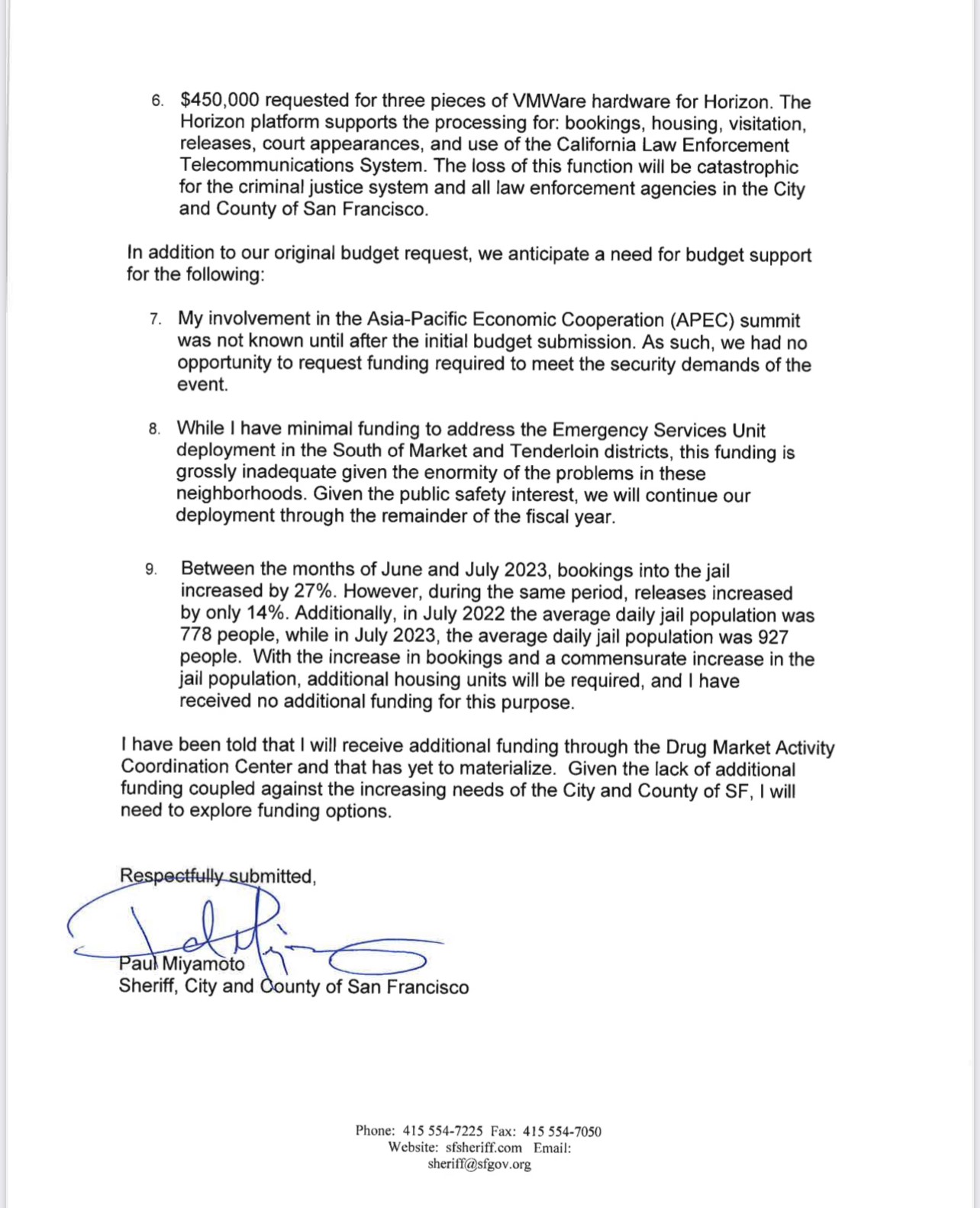


The Civilianization of Law Enforcement: Aligning with the Extreme Left’s Agenda

One prominent shift that has sent shockwaves through the San Francisco law enforcement landscape is the introduction of street crisis teams composed of Urban Alchemy workers, who now act as first responders in select situations. This marked transition towards civilianization of certain aspects of law enforcement has not only raised eyebrows but also drawn attention to its alignment with the extreme left’s agenda for criminal justice reform.

It is no secret that progressive elements on the political spectrum have long advocated for the civilianization of law enforcement, viewing traditional policing as inherently flawed and overly punitive. San Francisco’s embrace of this approach reflects a broader ideological shift, where the emphasis on community-based solutions and de-escalation tactics takes precedence over traditional law enforcement methods.

However, all one has to do is look around San Francisco to see that this approach is not working. The city’s streets are marred by open-air drug dealing, rampant crime, and a palpable sense of insecurity among its residents. Critics argue that while civilianization may have noble intentions, it has resulted in a system ill-equipped to address the complex and persistent challenges of urban safety.

While proponents argue that civilianizing law enforcement can lead to more empathetic and community-oriented policing, critics express concerns about the potential ramifications on public safety and law enforcement effectiveness. The debate over the civilianization of law enforcement is emblematic of the larger struggle between reformist ideologies and the need for maintaining public safety—a battle that is currently playing out in San Francisco’s streets and city halls.

Conclusion: A Critical Crossroads

The mounting evidence leaves little room for doubt – Mayor London Breed’s relentless assault on the San Francisco Sheriff’s Office is not just a byproduct of her commitment to criminal justice reform; it’s a calculated and multifaceted agenda. As the city grapples with these complex issues, the delicate balance between reform and public safety teeters on a precipice. The choices made in the coming months will undoubtedly have profound and lasting consequences for the city and its residents, defining the future of criminal justice in San Francisco.
 

“Paid for by the San Francisco Deputy Sheriffs’ Association PAC. Not authorized by a candidate or committee controlled by a candidate. Financial disclosures are available at sfethics.org.”

Ensuring Public Safety: The Vital Need for Armed Peace Officers in the Medical Examiner’s Office

SF Medical Examiner Investigator In recent times, the role of peace officers within the Medical Examiner’s Office has come under scrutiny. The issue at hand revolves around the authorization for these peace officers to carry firearms on duty. Our union, recognizing the potential risks and the impact on public safety, initiated a letter correspondence with the Medical Examiner’s Office. This article delves into the critical importance of arming these peace officers and highlights our recent response to address the matter.

The Medical Examiner’s Office plays a crucial role in investigating deaths and providing critical insights into the causes. However, it is essential to acknowledge that these investigations often take place in challenging environments, including high crime areas. The presence of peace officers within the Medical Examiner’s Office is not a mere formality; it serves as a vital component in ensuring the safety of all involved.

Our Initial Request: Recognizing the potential dangers faced by Medical Examiner Investigators, our union penned a letter to the Medical Examiner’s Office, urging them to authorize peace officers to carry firearms on duty. We highlighted the detrimental impact of disallowing these peace officers from being armed and emphasized the negative implications on public safety. It was our firm belief that by granting them the ability to carry firearms, we could enhance their capacity to respond to emergencies, protect themselves, and effectively fulfill their responsibilities.

The Medical Examiner Office’s Response: In their response, the Medical Examiner’s Office downplayed the peace officerCA Peace Officer Standards and Training designation within their agency and did not even acknowledge that they have California Peace Officer Standard of Training Certification, emphasizing their civilian-led approach. While we appreciate their perspective, it is crucial to recognize that peace officers play a pivotal role in enforcing laws, protecting the public, and responding to emergencies. Dismissing their authority and the need for them to be armed undermines their effectiveness and compromises the safety of both the investigators and the communities they serve.

In our recent response to the Medical Examiner’s Office, we reiterated the criticality of authorizing peace officers within the Medical Examiner’s Office to carry firearms on duty. We emphasized that this decision was not a form of defunding police power but rather a proactive measure to enhance public safety. By enabling our Medical Examiner Investigators to be armed, we ensure they have the means to protect themselves, others, and intervene in potentially dangerous situations. Moreover, it alleviates the burden on local law enforcement agencies, enabling them to allocate resources more efficiently.

The ongoing dialogue between our union and the Medical Examiner’s Office highlights the pressing need to address the issue of arming peace officers within the Medical Examiner’s Office. It is vital to recognize that public safety should always remain a top priority. By granting peace officers the ability to carry firearms, we can ensure the safety of our investigators and enhance their effectiveness in responding to emergencies. It is our hope that the Medical Examiner’s Office will reevaluate their stance and take decisive action that aligns with the shared commitment to public safety.

Together, let us work towards a safer future, where peace officers in the Medical Examiner’s Office can perform their duties without compromising their safety or the safety of the public they serve.

Ken Lomba
President, San Francisco Deputy Sheriffs’ Association
Representing the OCME Investigators
(415) 696-2428