San Francisco Sheriff’s Office Takes Bold Action as Mayor Breed’s Strategies Fall Short in Drug Crisis

In a stunning turn of events, the San Francisco Sheriff’s Office has emerged as the driving force in the fight against the escalating drug crisis, as Mayor London Breed’s strategies continue to fall short. With the city grappling with drug-related issues, Sheriff Paul Miyamoto has taken decisive action, unveiling a courageous plan to deploy 130 additional deputies to the troubled Tenderloin and South of Market (SoMa) neighborhoods.

SF Sheriff Tenderloin Initiative

While Mayor Breed’s approach has faced criticism for its ineffectiveness, Sheriff Miyamoto has stepped up to lead the charge in tackling the deep-rooted drug problem. With resolute determination, the Sheriff’s Office has presented a comprehensive strategy to address drug dealers and individuals openly using drugs in public. The deployment of additional deputies, starting this month, signifies a seismic shift in the battle against crime and substance abuse.

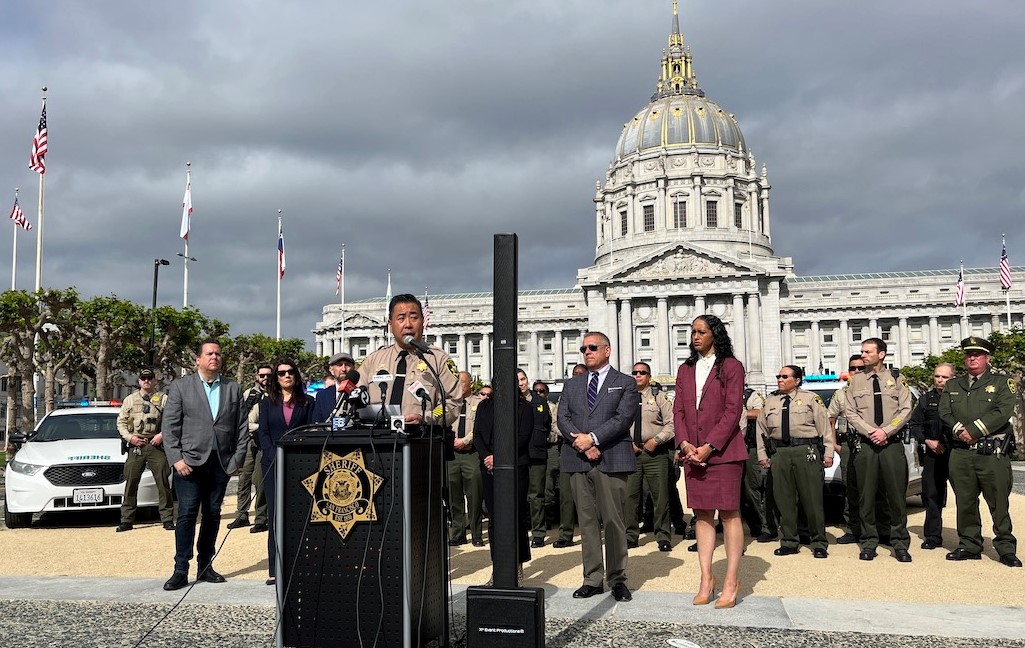
Sheriff Miyamoto, flanked by concerned citizens and law enforcement officials, announced this groundbreaking initiative outside City Hall. With unwavering resolve, he highlighted the urgent need for effective action in combating the city’s drug crisis. The Sheriff’s Office, guided by a steadfast commitment to public safety, is now taking the reins in the quest to find real solutions.

While the Sheriff’s Office courageously assumes a leading role, it is no secret that Mayor Breed’s strategies have fallen short of expectations. The current approach has been marred by limited success and persistent challenges. Public health experts have long decried the idea of relying on incarceration and criminalization as effective means to address substance abuse disorders.


However, the San Francisco Sheriff’s Office’s proactive stance offers hope for a different path forward. By increasing law enforcement presence and targeting drug-related offenses, they aim to restore order and offer a helping hand to those struggling with addiction. The Sheriff’s Office’s unwavering dedication to the community’s well-being is a testament to their commitment to creating lasting change.

Nevertheless, significant hurdles remain in this uphill battle. Both the San Francisco Police Department and the Sheriff’s Office confront staffing shortages that hinder their ability to effectively address the city’s safety concerns. Police Chief Bill Scott emphasized the importance of receiving adequate funding and support from elected officials to overcome these challenges. The commitment of city leaders to address staffing issues will be crucial in achieving tangible progress.

As the San Francisco Sheriff’s Office takes bold strides in confronting the drug crisis, it is evident that their approach stands in stark contrast to Mayor Breed’s faltering strategies. With their specialized training and unwavering dedication, the Sheriff’s Office deputies will fearlessly patrol the streets, tackling criminal elements head-on and extending a lifeline to those lost in the grips of addiction.

While the Sheriff’s Office shoulders the burden of this monumental task, it is vital for the community to rally behind them. Together, we can bring about meaningful change, ensuring a safer and healthier future for San Francisco. Let us unite in support of the determined men and women of the San Francisco Sheriff’s Office as they lead the charge to reshape our city’s destiny in the face of a daunting drug crisis.

Mayor London Breed’s Covert Defunding Tactics: Undermining the Sheriff’s Department

FOR IMMEDIATE RELEASE

Mayor London Breed’s strategic defunding of the Sheriff’s Department in San Francisco has ignited concerns among law enforcement officials and citizens alike. Operating under the radar, these silent defunding measures, such as the denial of the longevity incentive proposal on May 15th, 2023, and disproportionate budget cuts, are adversely impacting the department’s staffing levels and compromising public safety. Let’s examine these covert actions and their potential ramifications on the Sheriff’s Department.

Denial of Longevity Incentive Proposal

One glaring example of Mayor Breed’s covert defunding strategy is the denial of the longevity incentive proposal. On May 15th, 2023, Mayor Breed rejected this proposal aimed at retaining experienced deputies eligible for retirement, and she also failed to come to the table with a counter proposal or offer any alternative ideas to address the issue. This lack of engagement and proactive effort from the mayor demonstrates a concerning disregard for the retention of deputy sheriffs and exacerbates the ongoing staffing crisis within the Sheriff’s Department. The loss of 50 to 110 deputies due to early retirement further strains the department, leading to increased workloads, reduced efficiency, and compromised public safety.

Budget Cuts and Disproportionate Allocation

Mayor Breed’s budget decisions further illustrate her covert defunding tactics. While slashing the Sheriff’s Department budget by 3%, the mayor simultaneously increased the budgets of other public safety departments, such as the police by 9% and the fire department by 3%. This disproportionate allocation sends a troubling message about the mayor’s priorities and undermines the Sheriff’s Department’s ability to effectively carry out its duties.

Unused Funds and Overtime Reduction

The mayor’s claim of utilizing unused funds from vacant positions and reducing overtime within the Sheriff’s Office raises questions about the allocation of resources. If these funds were available, they could have been redirected to support initiatives like the longevity incentive proposal, thereby mitigating staffing shortages and reducing the need for overtime. However, the failure to do so implies a disregard for the long-term sustainability of the department and places an unnecessary burden on the existing workforce.

Implications for Public Safety and Financial Efficiency

The consequences of Mayor Breed’s covert defunding tactics extend beyond understaffing. Insufficient staffing levels compromise response times, limit the department’s ability to proactively address emerging challenges, and hinder the delivery of essential services to the community. Moreover, the reliance on overtime to fill vacant positions not only strains the budget but also places an additional burden on the dedicated deputies who shoulder the increased workload.

A Call for Accountability and Transparency

In light of these concerning developments, it is crucial for concerned citizens, deputies, and community stakeholders to hold Mayor London Breed accountable for her silent defunding strategies. The Sheriff’s Department plays a vital role in maintaining public safety, and it deserves the necessary resources and support to fulfill its duties effectively.

Additionally, transparency and open dialogue are imperative in addressing these budgetary concerns. Citizens must demand clear explanations and justifications for the disproportionate budget cuts and the denial of proposals aimed at retaining experienced deputies. By fostering transparency, the community can actively participate in shaping a fair and effective criminal justice system that prioritizes public safety.

Mayor London Breed’s covert defunding tactics targeting the Sheriff’s Department in San Francisco have serious implications for public safety and the well-being of the community. The denial of the longevity incentive proposal on May 15th, 2023, without offering any alternative solutions, and the disproportionate budget cuts jeopardize the department’s staffing levels, hindering its ability to maintain law and order effectively. It is essential for citizens and stakeholders to voice their concerns, demand accountability, and advocate for the allocation of resources that align with the department’s needs. Only through open dialogue and collaborative efforts can we ensure a robust and secure future for the Sheriff’s Department and the community it serves. By holding Mayor Breed accountable for her silent defunding strategies, we can work towards a fair and effective criminal justice system that prioritizes public safety and upholds the principles of justice and equality.


Media Contact:

Ken Lomba
President
San Francisco Deputy Sheriffs’ Association
415-696-2428

Support Pro Public Safety Candidates and Ballot Measures in San Francisco

San Francisco Deputy Sheriffs' Association PAC Pro Public SafetyThe San Francisco Deputy Sheriffs’ Association PAC plays a vital role in promoting the interests of public safety and law enforcement within our city. Our mission is to advocate for pro public safety candidates and ballot measures that will enhance the safety and security of our neighborhoods, protect our communities, and provide our brave deputy sheriffs with the resources they need to serve and protect.

Your generous contribution will make a significant impact on our ability to endorse and support candidates who share our vision of a safer San Francisco. By supporting these pro public safety individuals, we can ensure that our city’s law enforcement agencies have the necessary support, tools, and policies to effectively combat crime, respond to emergencies, and maintain peace and order.

Furthermore, your donation will allow us to back critical ballot measures that address key public safety issues, such as improving community policing efforts, investing in modern law enforcement technologies, and strengthening crime prevention programs. Together, we can shape the future of public safety in San Francisco and create a safer environment for all residents.

As a valued supporter, you have the opportunity to influence the direction of our city’s public safety policies and the well-being of our law enforcement officers. Your contribution to the San Francisco Deputy Sheriffs’ Association PAC will directly impact the success of our endorsed candidates and initiatives, fostering positive change within our community.

We invite you to join us in our mission to enhance public safety in San Francisco. Your generous donation of $25 will help us amplify our collective voice and bring about the necessary changes to protect our neighborhoods, families, and businesses.

To make a donation, please visit our secure online donation portal at https://fundly.com/san-francisco-deputy-sheriffs-association-pac Alternatively, you can mail your contribution or contact us directly at 415-696-2428 to discuss other giving options or answer any questions you may have.

Together, we can build a safer San Francisco for generations to come. We sincerely appreciate your consideration and support. Join us in our commitment to public safety and make a difference today.

Thank you for your unwavering support.

Sincerely,

Ken Lomba
SFDSA President
San Francisco Deputy Sheriffs’ Association PAC
P.O. Box 77590
San Francisco, CA 94107

Car break-ins are a major problem in San Francisco

Car break-ins are a major problem in San Francisco, with thousands of incidents reported every year. In fact, San Francisco has one of the highest rates of car break-ins in the country. This can be a frustrating and costly experience for car owners. However, there is a solution that can help reduce the risk of break-ins – security window tinting.  Make it difficult for the thieves.

car break ins

Security window tinting is a type of window film that is designed to make your car’s windows stronger and more difficult to break. It works by adding an extra layer of protection to your car’s windows that makes it much harder for a thief to break in. Here are some of the ways that security window tinting can help reduce break-ins in San Francisco:

  1. Deterrent Effect

Thieves are often looking for easy targets – cars that they can break into quickly and without being noticed. By adding security window tinting to your car, you are making it more difficult and time-consuming for a thief to break in. This can act as a deterrent, making your car less attractive to potential thieves.

  1. Reduced Visibility

Security window tinting also reduces the visibility into your car, making it harder for thieves to see what’s inside. This can help prevent smash-and-grab break-ins where a thief breaks a window and quickly grabs whatever they can see. With security window tinting, they are less likely to see anything valuable inside and may move on to an easier target.

  1. Increased Durability

Security window tinting is made of a strong, multi-layered film that is 4 mil. in thickness and designed to hold your car’s windows together even if they are shattered. This can help prevent a thief from gaining access to your car, and also reduces the risk of injury if the windows are broken during a break-in.

  1. Heat Reduction

In addition to its security benefits, window tinting can also help reduce the amount of heat that enters your car, making it more comfortable to drive and reducing the need for air conditioning. This can be particularly beneficial in San Francisco’s warm climate.

  1. UV Protection

Window tinting can also protect your car’s interior from the damaging effects of the sun’s UV rays, which can cause fading and cracking over time. This can help maintain the value of your car and keep it looking newer for longer.

Installing security window tinting on your car is a relatively quick and easy process that can be done by a professional. Once installed, the tinting requires little to no maintenance and can last for many years. It is also a cost-effective solution for reducing the risk of break-ins in San Francisco.  Here is an example of security window tint and some locations of installers https://www.3m.com/3M/en_US/p/d/b00016706/

In conclusion, if you want to protect your car from break-ins in San Francisco, security window tinting is a smart investment. It can act as a deterrent, reduce visibility, increase durability, and provide additional benefits such as heat reduction and UV protection. By adding this extra layer of protection to your car’s windows, you can enjoy greater peace of mind and reduce the risk of becoming a victim of car break-ins.

SFPOA’s “SFO Training” Debunked

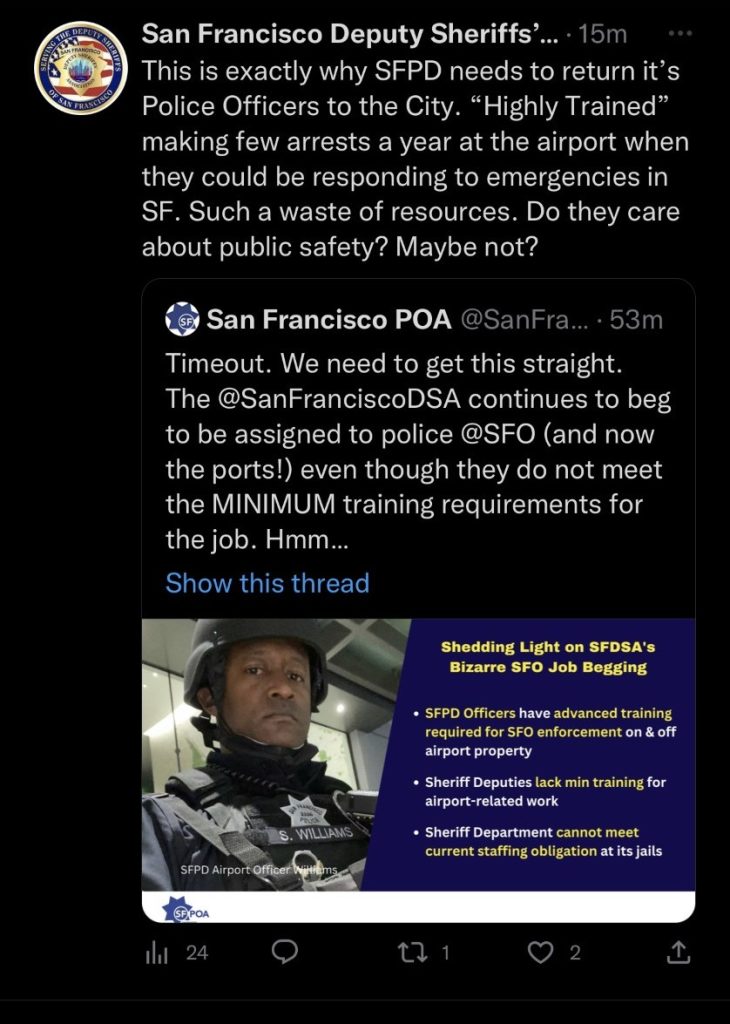
The San Francisco Police Officers Association (SFPOA) has recently raised concerns on Twitter about advanced officer training requirements for San Francisco Deputy Sheriffs to work at the city’s airport, SFO. However, upon closer examination, it is clear that the training in question is not as difficult or time-consuming as the SFPOA suggests.

SFO Airport Police

The “training” referred to by the San Francisco Police Officer Association is the California POST Aviation Security Training, a one-week, 40-hour course available to all law enforcement officers, not just the SFPD. The course covers the history of aviation security, introduction to the airport environment, criminal threat to the aviation industry, agencies and jurisdictions involved in airport security (such as the TSA, FBI, CBP, and USSS), legal aspects of aviation security, and the responsibilities of law enforcement officers working in an airport setting.

This training is not particularly difficult, and can easily be completed by San Francisco Deputy Sheriffs to meet the requirement to work at SFO. By allowing the SFPD to shift some of the police officers currently working at the airport back to the city, it will alleviate the staffing pressures on the SFPD and allow for a more efficient use of resources.

One solution is to grandfather in any SFPD officers close to retirement at the airport, and then work with the Sheriff to create a phased staffing plan that would allow for a percentage of police officers at the airport to return to SF to patrol in the City. This phased approach would ensure a smooth transition and allow for adequate staffing at the airport while also relieving pressure on the SFPD.

In conclusion, the minimum training requirements for San Francisco Deputy Sheriffs to work at SFO are not as difficult or time-consuming as the SFPOA suggests. By allowing the SFPD to shift some of its officers back to the city, it will alleviate staffing pressures and allow for a more efficient use of resources. The SFDSA will work with the Sheriff to create a functional staffing plan and assist with recruiting to ensure a smooth transition.

OPEN LETTER TO SFPD CHIEF SCOTT – CURRENT STATE OF SFPD

Dear Chief Scott,

I am writing to express my concern about the current state of the San Francisco Police Department and to offer a potential solution to improve efficiency and increase police staffing.

As you are aware, the police department is facing mass retirements and is currently understaffed. This is a major issue, as it leaves our city vulnerable to increased crime and puts an undue burden on the remaining officers who are trying to do their best to serve and protect the community.

In order to address this issue, I believe it would be beneficial to reduce the size of the police department and turn over some functions, such as the SFO, to the San Francisco Sheriff. By reassessing the roles and responsibilities of the department, we can redirect resources towards increasing the number of police officers in San Francisco, particularly in high-need areas like the Tenderloin district.

I understand that such a change would require careful consideration and planning, but I believe it is a common sense solution that would ultimately improve public safety for San Franciscans. By streamlining the department and focusing on core functions, we can ensure that your SFPD officers are able to do their jobs more effectively and efficiently.

I also believe that turning over auxiliary functions, such as the SFO, marine unit, and port patrols, to the Sheriff’s Department makes sense. The Sheriff’s Department is equipped to handle these types of tasks, and it would free up additional resources for the SFPD to focus on crime reduction and public safety in the city.

Given the current state of public safety in San Francisco, we have concerns for the well-being of our union members who reside in the city.  I hope that you will seriously consider this proposal and take any necessary steps to make it a reality. As the leader of the SFPD, it is your responsibility to ensure that the department is functioning at its best and that our city is as safe as possible. I believe that implementing these changes would be a step in the right direction towards achieving that goal.

Thank you for your attention to this matter.

Sincerely,

Ken Lomba
SFDSA President
415-696-2428

SFDSA Files Lawsuit Against SF Sheriff

At some time prior to July 8, 2022, the City and County of San Francisco Sheriff’s Office decided to create a pilot program in County Jail #3 (“CJ3”) in housing unit 5. The San Francisco Sheriff’s Office had two employees evaluate the functionality of the program and identify any concerns they saw with the changes proposed by the Sheriff’s Office. These deputies found numerous safety concerns that made it difficult to perform the regular safety checks of the inmates in some cases and completely impossible in other cases.

Despite the safety concerns, on July 8, 2022, the changes were implemented.

CJ3 has multiple housing units that are the shape of a circle with inmate cells on the perimeter of the circle. This circle is divided into to sides, the A and B sides. Inmates from A cannot cross over to B and vice versa. On one side of the dividing line is a “Crow’s Nest” or a tower with windows that can look out over portions of both the A and B sides of the housing unit. This Crow’s Nest has previously not been used.

Prior to July 8, 2022, CJ 3 has always had 2 deputies working a general population housing unit. One each on the A and B sides. These deputies worked on the floor with the inmates.

Safety Checks are required to be done every hour. There are state laws, known as Title 15 rules, as well as a San Francisco Sheriff’s Office policy, CODM 4.04, which outline the minimum requirements for these safety checks. The purpose of the checks is to maintain safety and security in the jail for staff, visitors and the inmates. Some of the requirements of these checks include noting the skin color of the inmate, the rise and fall of the chest, movement that indicates life, looking for any signs of illness or distress, inspection of cell doors and windows and a search for any apparent contraband or hazards.

These safety checks were completed by the deputies working on the floor but walking up to each inmate cell door and observing the inmate, the cell and surrounding area. Sometimes, at night, a flashlight would be required to properly check the welfare of the inmates.

On July 8, 2022, this changed. No longer would there be any floor deputies. Now, only one deputy, instead of two, would monitor all the inmates by him/herself, from the Crow’s Nest. In the event of an emergency, the deputy in the Crow’s Nest was not to leave and assist an inmate having a medical emergency, being attacked, or attempting to harm himself, instead, the deputy is now required to call for help. Deputies who are roaming around the rest of the jail would then have to respond and handle the situation, wasting valuable time.

The San Francisco Sheriff’s Office was unable to remedy all the safety concerns raised by the two employees who evaluated the new Crow’s Nest plan. The San Francisco Sheriff’s Office administration directed Crow’s Nest deputies to utilize binoculars to assist them in seeing the inmates better. While this may help with viewing some of the inmates when the lights are on, they do little to help at night and cannot solve the problem of the inability to see some of the cells at all, with or without binoculars.

The DSA sent a letter to the San Francisco Sheriff’s Office on July 18, 2022 and it was resent to the Director of Employee Relations, on July 22, 2022. This letter demanded that the new Crow’s Nest practice stop until the parties can meet and confer over the impacts and effects of it. Numerous impacts and effects were listed in this notice.

The San Francisco Sheriff’s Office responded on July 26, 2022, refusing to maintain the status quo until the parties were able to meet and confer.

Within days of its implementation, a fight broke out in one of the cells in the evening and it was not discovered until the next morning. This is evidence of the lack of safety the DSA was concerned with when it demanded the San Francisco Sheriff’s Office cease and desist its new Crow’s Nest practice.

March 28, 2022 RFI.

On March 28, 2022, the DSA requested information necessary and relevant to ascertain the dates, times, and shifts that the San Francisco Sheriff’s Office fell below the minimum staffing required by the MOU. (Exhibit X) Arbitrator Alexander Cohen previously resolved a grievance filed by DSA when the San Francisco Sheriff’s Office previously violated the Minimum Staffing section of the MOU. Arbitrator Cohen issued his ruling in favor of the DSA in 2017 in favor of the DSA. In his decision, he awarded damages to be paid to those members who worked on shifts that were below the minimum staffing required by the MOU. Because the San Francisco Sheriff’s Office continued to fall below the minimum staffing, the DSA filed a new grievance on March 4, 2022. The RFI filed on March 28, 2022 was to gather necessary and relevant information to calculate the damages incurred by the DSA members as the result of the San Francisco Sheriff’s Office’s current grievance for again violating the MOU. (Lomba Decl. ¶ 9)

The March 28, 2022 RFI was acknowledged received by the City Attorney’s office and forwarded to the Employee Relations Division (ERD) to respond. No response from ERD was ever received. (Howell Decl. ¶ 6 and 9; Exhibit 3) On May 2, 2022, the DSA followed up with ERD and the City Attorney’s office and demanded production of the RFI by May 9, 2022, which never came. (Howell Decl. ¶ 10 and 11; Exhibit 5)

On May 13, 2022, the DSA filed a First Amended Unfair Labor Practice Charge in PERB Case No. SF-CE-1794-M to have this matter added to that current litigation. On June 7, 2022, after filing the amendment to the PERB Charge, the San Francisco Sheriff’s Office produced documents responsive to the March 28, 2022 RFI. Judge Cloughesy declined to amend the Charge and Complaint in that matter to include this RFI issue but gave leave to refile this matter with PERB.

February 16, 2022 RFI.

On February 16, 2022, the DSA requested information necessary and relevant to ascertain the names, dates, and hours of Overtime Pay DSA members were denied. Information was also requested to ascertain the history, deliberation, changes, analysis and communications regarding Administrative Code section 18.13 involving the maximum permissible overtime. This information is necessary for the DSA to enforce the contract at a grievance proceeding and is unable to establish the damages or the individual DSA members affected, without the response to the RFI.

The February 16, 2022 RFI was acknowledge received by the City Attorney’s Office on February 22, 2022, via email. (EXHIBIT XX – email from KNS to Rapoport and back) Having received no responsive documents, the DSA’s counsel sent an email on August 2, 2022 to demand production. (Exhibit XX – Email KNS to)


 Contact:

Ken Lomba
SFDSA President
415-696-2428
San Francisco, CA

Forced Overtime at San Francisco Sheriff’s Office

The San Francisco Sheriff’s Office has a history of conducting salary savings.  Salary savings is a scheme to reduce hiring and offer overtime to existing employees.  In small cases it may be okay since the department can offer overtime to volunteers but over the years the San Francisco Sheriff’s Office has taken it to an extreme ordering our deputy sheriff members mandated overtime involuntarily.

For the purposes of this article, “salary savings” will be defined as the practice of keeping open positions unfilled so as to reduce budgetary outlays. In the practice, current employees are asked and often mandated to work overtime hours to cover the gaps created by non-hiring. As numerous articles and internal documents will show, the San Francisco Sheriff’s Office has engaged in salary savings for at least the last decade. While this has resulted in higher wages due to overtime payments, it has more significantly resulted in force attrition and individual exhaustion. This practice is not sustainable.

The San Francisco Sheriff’s Office has at times requested and at times mandated that its deputies work excessive hours of overtime to cover staffing shortages. As the Controller’s Annual Overtime Report (FY 2017-18) states, “[t]he distribution of overtime in the Department is highly skewed.” It has rewarded some, those willing to work extravagant amounts of time, with salaries far exceeding their base and it has also hastened the retirement of those who value their days off and their health. Meanwhile, until very recently, the Department has not incurred new pensions or benefit costs and has not had to train new employees sufficient to fill its roster. As numerous documents have shown, by encouraging and demanding overtime and by failing to hire new deputies, the Department has engaged in salary savings for at least the last decade.

Fast forward to present time, the Sheriff’s Office has gone further with this practice and implemented more salary savings.  As of a January 2021, the Sheriff’s Office had approx. 203 vacant full time employee openings.  It most likely is even higher now.  The Sheriff Office now mandates more overtime and blocks volunteers, in most cases, from working overtime forcing more deputy sheriffs to work involuntarily and in most cases forced to work with last minute notice.  You can only imagine how disruptive this is to the deputy sheriffs’ lives and health.

SF Deputy SheriffIn February 2021, the San Francisco Sheriff’s Office prepared their budget request, within that request they only asked for funding for 44 deputy sheriff positions.  This number is extremely low with deputies retiring and leaving to other agencies as well as the existing approx. -203 full time employee vacancies.

In August 2020 the San Francisco Chronicle reported that 19 out of 20 of the City’s Top Biggest Overtime Earners were deputy sheriffs.  That brought a lot of attention to the Sheriff’s Office and could expose the salary savings scheme to the voters.  So what they did next should shock you!  Instead of hiring more deputies to reduce the overtime, they are now forcing more deputies to work overtime.  They are restricting volunteers and forcing more involuntarily.  Is this a San Francisco value?

The staffing shortage not only effects the safety of employees and public but it also affects the currently incarcerated people.  Lawsuits are mounting for not allowing the currently incarcerated to have exercise time, walk time, sunshine time and now law suits over sleep deprivation.  The next lawsuit will most likely be a federal class action lawsuit over the lack of staff and conditions in the jail for violating the rights of the currently incarcerated.

While businesses continue to struggle and unemployment exceeds six percent the City gained a budget surplus of $125 Million this fiscal year 2020-2021.  So it makes you wonder why the Sheriff’s Office is so timid with it’s budget requests with such a staffing deficit.  

Download our white paper on San Francisco Sheriff’s Office Salary Savings.

San Francisco Deputy Sheriff catches Robbery Suspects

On the morning of January 5, 2016, San Francisco Deputy Sheriff D. Perez, while off duty and walking his dog, observed two men behaving erratically and shadowing a younger man, possibly with the intention of robbing him.

PerezDeputy Perez immediately texted a friend at the San Francisco Department of Emergency Management dispatch center and learned that two men matching their description were being sought by the San Francisco Police Department.

Deputy Perez provided the SFPD with the suspects’ location. Once the suspects were detained, officers informed Deputy Sheriff Perez that the men were also suspects in other robberies and attempted robberies in the area.

“In this situation Deputy Perez used his law enforcement experience while off duty to recognize potential criminal activity,” said Sgt. M. Kilgariff of San Francisco Sheriff”s Department Civil Section. “We are proud of his quick thinking and his resourcefulness in identifying the two suspects.”