FOR IMMEDIATE RELEASE
Deputy’s Rapid Response at ZSFGH Likely Prevented Mass Casualty Stabbing — But Security Plan Still Keeps Deputies Out of Most Crises
Deputy Sheriffs say DPH’s BERT model minimizes law-enforcement presence and relies on unarmed security in a vertical city of high-risk patients
 San Francisco, CA — The San Francisco Deputy Sheriffs’ Association (SFDSA) is calling attention to the heroic actions of a Sheriff’s deputy at Zuckerberg San Francisco General Hospital (ZSFGH) and renewing its warning that the hospital’s current security model is designed to keep deputies out of most violent incidents while relying on unarmed security and clinical teams.
On December 4, 2025, a stabbing in Ward 86, ZSFGH’s HIV clinic, left UCSF social worker Alberto Rangel with multiple stab wounds. Despite rapid intervention and lifesaving efforts, Mr. Rangel later died from his injuries.
SFDSA President Ken Lomba says that while the deputy could not undo the initial wounds, his rapid intervention almost certainly prevented additional victims.
“What people aren’t being told is that our deputy didn’t just confront one dangerous situation — he likely prevented a mass-casualty stabbing inside that clinic,” Lomba said. “Ward 86 is a high-volume HIV clinic. If the assailant had been able to move freely down the hallway, we could be talking about multiple staff and patients stabbed. The only reason that didn’t happen is because a deputy was close enough to intervene within seconds.”
Unarmed security at the entrance, no fixed deputy post in the 80/90 complex
Under ZSFGH’s current security model, Building 80 – which houses the Ward 86 HIV clinic on the 6th floor – is part of the connected 80/90 complex, with its main public entrance on 22nd Street. According to our union members assigned to ZSFGH, that entrance is staffed by an unarmed private security guard seated at a desk, and DPH relies on additional private security guards who patrol the building’s interior. There is no fixed Sheriff’s deputy post in Building 80.
SFDSA later discovered, through its staffing records, that Building 80 previously had a Sheriff’s cadet post, but DPH eliminated that post in July 2025, leaving only unarmed private security at the public entrance and in the hallways.
In the connected Building 90, ZSFGH operates Ward 93, an Opiate Treatment Outpatient Program (OTOP) methadone clinic on the third floor. Public information lists Ward 93 as a methadone clinic serving adults with substance-use disorders, and our union members report that DPH assigns a private armed security guard inside Unit 93 who is not permitted to leave that unit. That means the one armed security presence in the 80/90 complex is effectively locked to a single clinic, while the rest of the building — including the path to Ward 86 — is covered only by unarmed guards and a greatly reduced number of deputies.
On December 4, a stabbing occurred in the 6th-floor Ward 86 hallway, where UCSF social worker Alberto Rangel was repeatedly stabbed and left in critical condition. An individual was later arrested on suspicion of carrying out the stabbing. Based on information from our members, the individual possibly moved past the unarmed security presence at the 22nd Street entrance and through the 80/90 complex to reach the 6th floor.
The only sworn law-enforcement officer in Building 80 at that time was a Sheriff’s deputy temporarily assigned there solely because DPH had requested protection for a doctor who had previously reported threats from the same individual. When the stabbing began in another area in a hallway, that deputy responded, intervened to stop the attack, helped secure the individual, and allowed medical staff to begin lifesaving care.
“This was not a building with a strong law-enforcement presence,” Lomba said. “It was an unarmed guard at the lobby desk, a handful of roving security guards, no fixed deputy post, and a deputy in Ward 86 only because a doctor had already been threatened. In the end, the only person who physically restrained the suspect and stopped the stabbing was a sworn deputy sheriff.”
A missed opportunity at City Clinic and delayed law-enforcement notification
San Francisco City Clinic, located at 356 7th Street in SoMa, is a DPH sexual-health clinic that does not have any assigned Sheriff’s deputy post. According to public news reports, on the same day as the Ward 86 killing, hours before the stabbing, the same individual went to City Clinic looking for a specific doctor he had been threatening. A clinic director hid the doctor, told the individual the doctor was not there, and then heard the individual say he would go to Ward 86 at ZSFGH to find that doctor later that day. The clinic and the hospital are roughly two miles apart, yet there is no public indication in those reports that either SFPD or the Sheriff’s Office was contacted at that point so law enforcement could attempt to locate or intercept the individual before he reached Ward 86.
Under DPH’s own Threat Management policy, multiple threats combined with a stated plan to go to a specific location to find a targeted provider appear to meet the definition of a “High Risk” case—the very category where the policy warns of imminent danger of serious injury or death and directs staff to notify both SFSD and SFPD. SFDSA is therefore asking DPH to explain why law enforcement was not called from City Clinic when staff had both credible threats and advance notice of the individual’s stated destination, and why the Sheriff’s Office was only brought in shortly before the attack instead of at the earliest warning.
Unanswered questions about DPH’s own threat policy
Through a public-records request under the California Public Records Act (CPRA), SFDSA’s counsel obtained DPH’s Threat Management flowchart, which outlines how threats are supposed to be classified and handled. According to that document, cases are classified as “High Risk” when there are multiple threats of violence and evidence of a violent plan directed at a specific person or location. In those situations, the policy says there is a high probability of imminent danger of injury or death, and the response should include contacting both the Sheriff’s Office and SFPD.
Public news reports about this case describe an individual who threatened staff over a period of time, went to San Francisco City Clinic looking for a specific doctor, told the clinic director he would go to Ward 86 at ZSFGH to find that doctor, and then later allegedly carried out a stabbing in Ward 86. Taken together, those facts appear to fit the very “High Risk” scenario DPH’s own Threat Management policy describes: multiple threats combined with a clear plan to seek out a targeted provider at a specific location.
DPH’s Threat Management flowchart, as produced to SFDSA, states that when a situation is classified as “High Risk,” both the Sheriff’s Office and SFPD should be notified. In this case, a doctor at Ward 86 had already reported threats from the same individual, and DPH specifically requested that a Sheriff’s deputy be assigned to protect that doctor on the day of the stabbing.
SFDSA is calling on DPH and its security leadership to answer two basic questions:
-
How was this case formally classified under DPH’s Threat Management policy — Low, Medium, or High Risk?
-
If it was treated as High Risk, were both SFSD and SFPD notified in accordance with that policy — and if not, why not?
“DPH’s own document, which we obtained through a CPRA request, says multiple threats plus a violent plan aimed at a specific person equals High Risk and should trigger calls to both the Sheriff’s Office and SFPD,” Lomba said. “The publicly reported facts about this case look exactly like that scenario. The public deserves a clear answer: did DPH follow its own High-Risk protocol before this attack — yes or no?”
A security model built to keep deputies out of the room
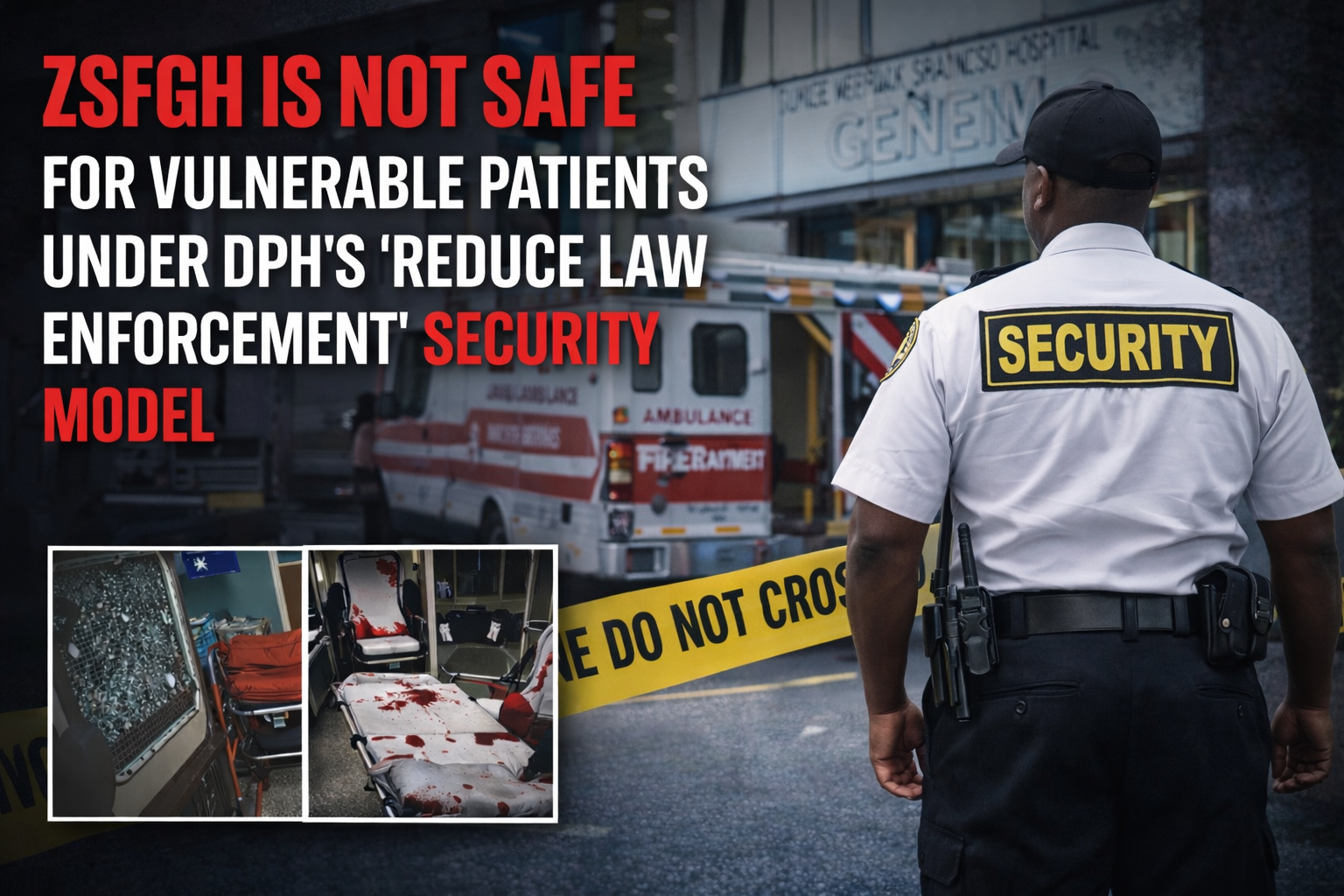
SFDSA says the tragedy in Ward 86 must be understood in the context of a security plan that intentionally reduced sworn staffing and routed most crises away from law enforcement.
In a series of plans and presentations to the Health Commission, the Department of Public Health (DPH):
-
Proposed cutting 11.4 deputy positions at ZSFGH, reducing deputies on the hospital work order from 30 FTE to 21 FTE.
-
Created a Behavioral Emergency Response Team (BERT) made up of psychiatric nurses and psych techs to respond to behavioral crises, perform de-escalation, administer medications, and manage restraints.
-
Chose to support BERT with non-uniformed cadets and private security personnel, rather than strengthening sworn coverage on high-risk units.
-
Reported that in the Emergency Department and other areas, over 80 percent of BERT activations now occur without any law-enforcement presence, and cited that as a success metric.
-
Stated that law-enforcement intervention could “have the unintended effect of escalating a situation” and described reducing the presence of deputies in DPH facilities as an explicit goal.
“DPH didn’t just trim numbers; they rewrote the model so that deputies are kept out of the room as much as possible,” Lomba said. “They built a system where psych staff, cadets, and unarmed guards are expected to handle the early, most dangerous seconds of an attack — and then deputies are supposed to show up later and clean up the aftermath.”
Not just one building — a vertical city of high-risk patients
The Association says this “response-only” approach is especially dangerous at ZSFGH because of how the campus is built and what it handles.
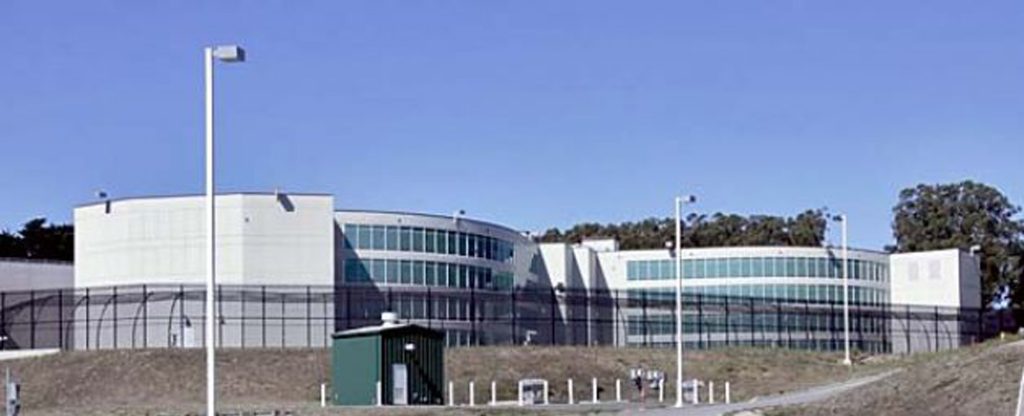
Zuckerberg San Francisco General is not a single hallway with a front desk. It is a dense, multi-building, multi-story campus of high-risk services:
-
San Francisco’s only Level-1 trauma center,
-
The City’s only 24/7 psychiatric emergency department, and
-
The primary safety-net hospital for many of the City’s most vulnerable residents, including people experiencing homelessness, serious mental illness, and substance-use disorders.
Multiple towers and specialty buildings — trauma and emergency, medical-surgical units, HIV and infectious-disease clinics like Ward 86, psychiatric emergency, acute psych, and high-risk outpatient programs — are stacked on top of one another and connected by elevators, stairwells, internal corridors, and secured passageways.
When a call comes in from an upper floor or a remote clinic, deputies must navigate multiple floors, secured access points, and crowded hallways before reaching the scene.
“On a campus like this, ‘response-only’ isn’t a theory problem; it’s a time-and-distance problem,” Lomba said. “Every minute of delay is more time for a stabbing, strangulation, or assault on staff to continue. When you cut deputies here, you don’t just pull them off one doorway — you thin sworn coverage across an entire vertical grid of trauma units, psych, and clinics all at once.”
Built on narrow statistics and flawed comparisons to LA and Alameda
DPH has repeatedly cited hospitals in Los Angeles County and Alameda County as models for its hybrid BERT and security approach. SFDSA argues those comparisons are fundamentally flawed:
-
LA and Alameda distribute trauma and psychiatric emergencies across multiple hospitals and trauma centers, with sheriff’s deputies and local police departments able to surge to incidents across a wide geographic area.
-
San Francisco concentrates most of that burden on one campus — ZSFGH — for roughly 1.5 million people in San Francisco and northern San Mateo County.
-
In the external systems DPH references, sworn law enforcement remains a core part of a co-responder model. At ZSFGH, the implementation has focused on reducing deputies and measuring success by how often BERT can operate without law enforcement present.
At the same time, DPH built its equity case on a narrow slice of data:
-
Internal memos and public statements highlighted that roughly half of use-of-force incidents in one reporting period involved Black patients, and that a high share of ED use-of-force involved Black patients compared to their percentage of ER visitors.
-
ZSFGH’s own annual reports, however, show that Black patients are about 12–15 percent of the hospital’s overall patient population, not 48–70 percent.
-
DPH has not publicly released the full breakdown of who is in the ED, PES, and psych units by race, or how many of those force incidents involved fights, weapons, or psychiatric restraints.
“DPH took a small number of high-risk incidents and used that percentage to argue deputies themselves were an ‘equity problem,’” Lomba said. “They never showed the full picture of who is in those units, why staff called for help, or how many times deputies prevented serious injury or death. That narrow statistic was then used to sell a plan that civilianized security and kept deputies out of the room.”
What SFDSA is demanding now
In light of the Ward 86 killing and the documented design of the ZSFGH security plan, SFDSA is calling for immediate changes:
-
Restore and expand assigned deputy-sheriff posts on high-risk units and posts at ZSFGH, including Ward 86, the Emergency Department, Psychiatric Emergency Services, and critical inpatient floors, with a fully staffed sworn patrol presence on campus.
-
End the experiment of replacing deputies with cadets, private security, and BERT-only responses in areas where staff routinely face weapons, severe psychiatric crises, and violent assaults.
-
Publish a full, unit-level analysis of use-of-force and patient demographics, so the public can see the true denominators behind DPH’s equity claims, including ED/PES/psych race breakdowns and the reasons staff call for help.
-
Establish an independent safety and equity review of the ZSFGH security model, including BERT, cadets, private security, and deputy staffing, with full participation from frontline unions representing deputies, nurses, physicians, social workers, and other hospital staff.
-
Adopt a true co-responder model in which BERT clinicians and deputies respond together to the most dangerous situations, instead of sending clinicians and non-sworn staff in first and treating law enforcement as a last resort.
“The deputy in Ward 86 did everything right and likely prevented more people from being stabbed,” Lomba said. “What failed that day was not the deputy — it was a security plan that deliberately kept most deputies away from high-risk units in the first place. That plan has to change before we lose anyone else.”
Media Contact
San Francisco Deputy Sheriffs’ Association
Phone: (415) 696-2428

 Zuckerberg San Francisco General Hospital (ZSFGH) is a city within a city—a dense, vertical campus with constant foot traffic, high-acuity medicine, psychiatric emergencies, and complex social-service needs moving through the same corridors. Vulnerable inpatients can’t “opt out” of that environment. They can’t leave when violence erupts. They depend on the hospital’s security posture to be strong, visible, and fast.