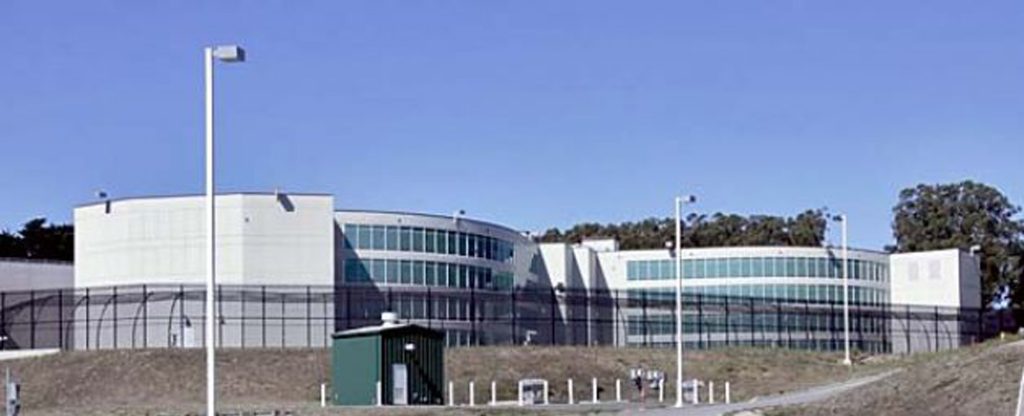
Deputy’s Rapid Response at ZSFGH Likely Prevented Mass Casualty Stabbing — But Security Plan Still Keeps Deputies Out of Most Crises

FOR IMMEDIATE RELEASE

Deputy’s Rapid Response at ZSFGH Likely Prevented Mass Casualty Stabbing — But Security Plan Still Keeps Deputies Out of Most Crises

Deputy Sheriffs say DPH’s BERT model minimizes law-enforcement presence and relies on unarmed security in a vertical city of high-risk patients
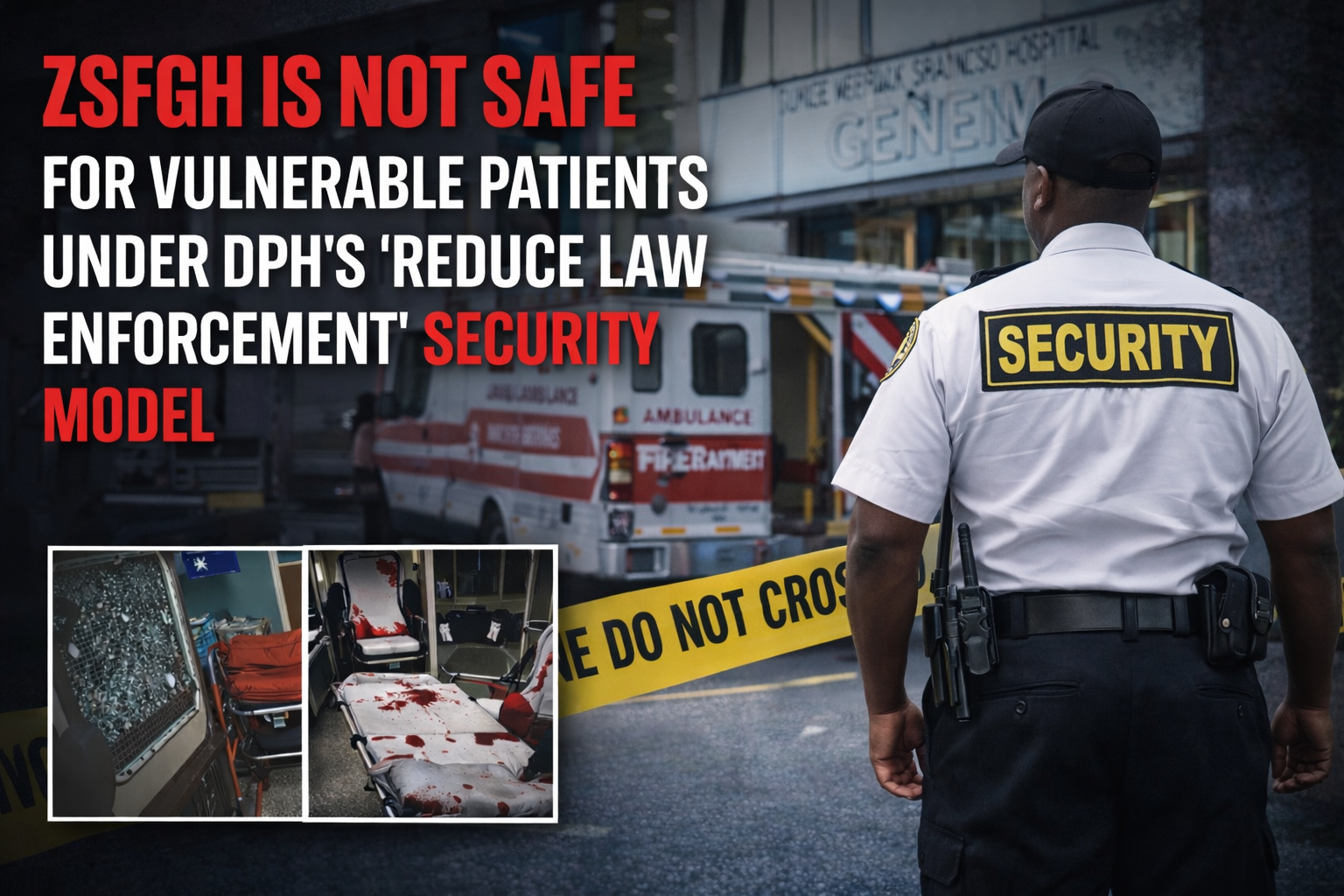
Deputy Saves ZSFGH Ward 86 from Mass StabbingSan Francisco, CA — The San Francisco Deputy Sheriffs’ Association (SFDSA) is calling attention to the heroic actions of a Sheriff’s deputy at Zuckerberg San Francisco General Hospital (ZSFGH) and renewing its warning that the hospital’s current security model is designed to keep deputies out of most violent incidents while relying on unarmed security and clinical teams.

On December 4, 2025, a stabbing in Ward 86, ZSFGH’s HIV clinic, left UCSF social worker Alberto Rangel with multiple stab wounds. Despite rapid intervention and lifesaving efforts, Mr. Rangel later died from his injuries.

SFDSA President Ken Lomba says that while the deputy could not undo the initial wounds, his rapid intervention almost certainly prevented additional victims.

“What people aren’t being told is that our deputy didn’t just confront one dangerous situation — he likely prevented a mass-casualty stabbing inside that clinic,” Lomba said. “Ward 86 is a high-volume HIV clinic. If the assailant had been able to move freely down the hallway, we could be talking about multiple staff and patients stabbed. The only reason that didn’t happen is because a deputy was close enough to intervene within seconds.”


Unarmed security at the entrance, no fixed deputy post in the 80/90 complex

Under ZSFGH’s current security model, Building 80 – which houses the Ward 86 HIV clinic on the 6th floor – is part of the connected 80/90 complex, with its main public entrance on 22nd Street. According to our union members assigned to ZSFGH, that entrance is staffed by an unarmed private security guard seated at a desk, and DPH relies on additional private security guards who patrol the building’s interior. There is no fixed Sheriff’s deputy post in Building 80.

SFDSA later discovered, through its staffing records, that Building 80 previously had a Sheriff’s cadet post, but DPH eliminated that post in July 2025, leaving only unarmed private security at the public entrance and in the hallways.

In the connected Building 90, ZSFGH operates Ward 93, an Opiate Treatment Outpatient Program (OTOP) methadone clinic on the third floor. Public information lists Ward 93 as a methadone clinic serving adults with substance-use disorders, and our union members report that DPH assigns a private armed security guard inside Unit 93 who is not permitted to leave that unit. That means the one armed security presence in the 80/90 complex is effectively locked to a single clinic, while the rest of the building — including the path to Ward 86 — is covered only by unarmed guards and a greatly reduced number of deputies.

On December 4, a stabbing occurred in the 6th-floor Ward 86 hallway, where UCSF social worker Alberto Rangel was repeatedly stabbed and left in critical condition. An individual was later arrested on suspicion of carrying out the stabbing. Based on information from our members, the individual possibly moved past the unarmed security presence at the 22nd Street entrance and through the 80/90 complex to reach the 6th floor.

The only sworn law-enforcement officer in Building 80 at that time was a Sheriff’s deputy temporarily assigned there solely because DPH had requested protection for a doctor who had previously reported threats from the same individual. When the stabbing began in another area in a hallway, that deputy responded, intervened to stop the attack, helped secure the individual, and allowed medical staff to begin lifesaving care.

“This was not a building with a strong law-enforcement presence,” Lomba said. “It was an unarmed guard at the lobby desk, a handful of roving security guards, no fixed deputy post, and a deputy in Ward 86 only because a doctor had already been threatened. In the end, the only person who physically restrained the suspect and stopped the stabbing was a sworn deputy sheriff.”


A missed opportunity at City Clinic and delayed law-enforcement notification

San Francisco City Clinic, located at 356 7th Street in SoMa, is a DPH sexual-health clinic that does not have any assigned Sheriff’s deputy post. According to public news reports, on the same day as the Ward 86 killing, hours before the stabbing, the same individual went to City Clinic looking for a specific doctor he had been threatening. A clinic director hid the doctor, told the individual the doctor was not there, and then heard the individual say he would go to Ward 86 at ZSFGH to find that doctor later that day. The clinic and the hospital are roughly two miles apart, yet there is no public indication in those reports that either SFPD or the Sheriff’s Office was contacted at that point so law enforcement could attempt to locate or intercept the individual before he reached Ward 86.

Under DPH’s own Threat Management policy, multiple threats combined with a stated plan to go to a specific location to find a targeted provider appear to meet the definition of a “High Risk” case—the very category where the policy warns of imminent danger of serious injury or death and directs staff to notify both SFSD and SFPD. SFDSA is therefore asking DPH to explain why law enforcement was not called from City Clinic when staff had both credible threats and advance notice of the individual’s stated destination, and why the Sheriff’s Office was only brought in shortly before the attack instead of at the earliest warning.


Unanswered questions about DPH’s own threat policy

Through a public-records request under the California Public Records Act (CPRA), SFDSA’s counsel obtained DPH’s Threat Management flowchart, which outlines how threats are supposed to be classified and handled. According to that document, cases are classified as “High Risk” when there are multiple threats of violence and evidence of a violent plan directed at a specific person or location. In those situations, the policy says there is a high probability of imminent danger of injury or death, and the response should include contacting both the Sheriff’s Office and SFPD.

Public news reports about this case describe an individual who threatened staff over a period of time, went to San Francisco City Clinic looking for a specific doctor, told the clinic director he would go to Ward 86 at ZSFGH to find that doctor, and then later allegedly carried out a stabbing in Ward 86. Taken together, those facts appear to fit the very “High Risk” scenario DPH’s own Threat Management policy describes: multiple threats combined with a clear plan to seek out a targeted provider at a specific location.

DPH’s Threat Management flowchart, as produced to SFDSA, states that when a situation is classified as “High Risk,” both the Sheriff’s Office and SFPD should be notified. In this case, a doctor at Ward 86 had already reported threats from the same individual, and DPH specifically requested that a Sheriff’s deputy be assigned to protect that doctor on the day of the stabbing.

SFDSA is calling on DPH and its security leadership to answer two basic questions:

  1. How was this case formally classified under DPH’s Threat Management policy — Low, Medium, or High Risk?

  2. If it was treated as High Risk, were both SFSD and SFPD notified in accordance with that policy — and if not, why not?

“DPH’s own document, which we obtained through a CPRA request, says multiple threats plus a violent plan aimed at a specific person equals High Risk and should trigger calls to both the Sheriff’s Office and SFPD,” Lomba said. “The publicly reported facts about this case look exactly like that scenario. The public deserves a clear answer: did DPH follow its own High-Risk protocol before this attack — yes or no?


A security model built to keep deputies out of the room

SFDSA says the tragedy in Ward 86 must be understood in the context of a security plan that intentionally reduced sworn staffing and routed most crises away from law enforcement.

In a series of plans and presentations to the Health Commission, the Department of Public Health (DPH):

  • Proposed cutting 11.4 deputy positions at ZSFGH, reducing deputies on the hospital work order from 30 FTE to 21 FTE.

  • Created a Behavioral Emergency Response Team (BERT) made up of psychiatric nurses and psych techs to respond to behavioral crises, perform de-escalation, administer medications, and manage restraints.

  • Chose to support BERT with non-uniformed cadets and private security personnel, rather than strengthening sworn coverage on high-risk units.

  • Reported that in the Emergency Department and other areas, over 80 percent of BERT activations now occur without any law-enforcement presence, and cited that as a success metric.

  • Stated that law-enforcement intervention could “have the unintended effect of escalating a situation” and described reducing the presence of deputies in DPH facilities as an explicit goal.

“DPH didn’t just trim numbers; they rewrote the model so that deputies are kept out of the room as much as possible,” Lomba said. “They built a system where psych staff, cadets, and unarmed guards are expected to handle the early, most dangerous seconds of an attack — and then deputies are supposed to show up later and clean up the aftermath.”


Not just one building — a vertical city of high-risk patients

The Association says this “response-only” approach is especially dangerous at ZSFGH because of how the campus is built and what it handles.

Zuckerberg San Francisco General is not a single hallway with a front desk. It is a dense, multi-building, multi-story campus of high-risk services:

  • San Francisco’s only Level-1 trauma center,

  • The City’s only 24/7 psychiatric emergency department, and

  • The primary safety-net hospital for many of the City’s most vulnerable residents, including people experiencing homelessness, serious mental illness, and substance-use disorders.

Multiple towers and specialty buildings — trauma and emergency, medical-surgical units, HIV and infectious-disease clinics like Ward 86, psychiatric emergency, acute psych, and high-risk outpatient programs — are stacked on top of one another and connected by elevators, stairwells, internal corridors, and secured passageways.

When a call comes in from an upper floor or a remote clinic, deputies must navigate multiple floors, secured access points, and crowded hallways before reaching the scene.

“On a campus like this, ‘response-only’ isn’t a theory problem; it’s a time-and-distance problem,” Lomba said. “Every minute of delay is more time for a stabbing, strangulation, or assault on staff to continue. When you cut deputies here, you don’t just pull them off one doorway — you thin sworn coverage across an entire vertical grid of trauma units, psych, and clinics all at once.”


Built on narrow statistics and flawed comparisons to LA and Alameda

DPH has repeatedly cited hospitals in Los Angeles County and Alameda County as models for its hybrid BERT and security approach. SFDSA argues those comparisons are fundamentally flawed:

  • LA and Alameda distribute trauma and psychiatric emergencies across multiple hospitals and trauma centers, with sheriff’s deputies and local police departments able to surge to incidents across a wide geographic area.

  • San Francisco concentrates most of that burden on one campus — ZSFGH — for roughly 1.5 million people in San Francisco and northern San Mateo County.

  • In the external systems DPH references, sworn law enforcement remains a core part of a co-responder model. At ZSFGH, the implementation has focused on reducing deputies and measuring success by how often BERT can operate without law enforcement present.

At the same time, DPH built its equity case on a narrow slice of data:

  • Internal memos and public statements highlighted that roughly half of use-of-force incidents in one reporting period involved Black patients, and that a high share of ED use-of-force involved Black patients compared to their percentage of ER visitors.

  • ZSFGH’s own annual reports, however, show that Black patients are about 12–15 percent of the hospital’s overall patient population, not 48–70 percent.

  • DPH has not publicly released the full breakdown of who is in the ED, PES, and psych units by race, or how many of those force incidents involved fights, weapons, or psychiatric restraints.

“DPH took a small number of high-risk incidents and used that percentage to argue deputies themselves were an ‘equity problem,’” Lomba said. “They never showed the full picture of who is in those units, why staff called for help, or how many times deputies prevented serious injury or death. That narrow statistic was then used to sell a plan that civilianized security and kept deputies out of the room.”


What SFDSA is demanding now

In light of the Ward 86 killing and the documented design of the ZSFGH security plan, SFDSA is calling for immediate changes:

  1. Restore and expand assigned deputy-sheriff posts on high-risk units and posts at ZSFGH, including Ward 86, the Emergency Department, Psychiatric Emergency Services, and critical inpatient floors, with a fully staffed sworn patrol presence on campus.

  2. End the experiment of replacing deputies with cadets, private security, and BERT-only responses in areas where staff routinely face weapons, severe psychiatric crises, and violent assaults.

  3. Publish a full, unit-level analysis of use-of-force and patient demographics, so the public can see the true denominators behind DPH’s equity claims, including ED/PES/psych race breakdowns and the reasons staff call for help.

  4. Establish an independent safety and equity review of the ZSFGH security model, including BERT, cadets, private security, and deputy staffing, with full participation from frontline unions representing deputies, nurses, physicians, social workers, and other hospital staff.

  5. Adopt a true co-responder model in which BERT clinicians and deputies respond together to the most dangerous situations, instead of sending clinicians and non-sworn staff in first and treating law enforcement as a last resort.

“The deputy in Ward 86 did everything right and likely prevented more people from being stabbed,” Lomba said. “What failed that day was not the deputy — it was a security plan that deliberately kept most deputies away from high-risk units in the first place. That plan has to change before we lose anyone else.”


Media Contact
San Francisco Deputy Sheriffs’ Association
Phone: (415) 696-2428

Internal DPH Memos Show ZSFGH Security Plan Was Built to Keep Deputies Out

FOR IMMEDIATE RELEASE

Internal DPH Memos Show ZSFGH Security Plan Was Built to Keep Deputies Out

Deputy Sheriffs’ Association says DPH cut sworn staffing, misused equity data, and spent more on an unproven BERT / private-security model before fatal stabbing of UCSF social worker

San Francisco, CA — The San Francisco Deputy Sheriffs’ Association (SFDSA) is releasing internal Department of Public Health (DPH) documents showing that security changes at Zuckerberg San Francisco General Hospital (ZSF GH) were deliberately structured to keep law enforcement out of most patient crises — even as weapons seizures, assaults, and workplace-violence incidents remained high.

On December 4, 2025, a UCSF social worker was fatally stabbed multiple times in Ward 86 at ZSF GH. A nearby deputy intervened, disarmed the attacker, and allowed staff to begin life-saving measures, but the victim later died. SFDSA President Ken Lomba says this tragedy is the predictable outcome of a policy that treated deputies as a problem to be reduced, not a safety partner to be strengthened.

“DPH used the language of ‘equity’ and ‘best practices’ to justify a security experiment that removed deputies from high-risk units and posts and replaced them with BERT clinicians, cadets, and unarmed guards,” said Lomba. “Their own memos brag that almost nine out of ten behavioral emergencies now happen with no law enforcement present. On Ward 86, we saw the real-world result of that decision.”


DPH’s own memos: cut deputies, keep them out of the room

In a June 14, 2021 Safety Services Staffing Plan Proposal, DPH proposed to:

  • Reduce Sheriff’s deputies at ZSF GH by 11.4 positions (about 14.5 FTE including backfill), and
  • Add 31.9 FTE of Psychiatry Nurses and Licensed Psychiatric Technicians, plus 2.5 FTE Care Experience Health Workers, to form a Behavioral Emergency Response Team (BERT).

The same plan specifies that non-uniformed cadets would provide clinical support in patient intervention, function as “healthcare ambassadors,” and conduct campus patrols.

A later August 28, 2023 Security Staffing Plan Update to the Health Commission reports that:

  • The plan would reduce deputies by 11.4 FTE and add 29.4 FTE of BERT staff to create a 24-hour BERT program in the Emergency Department.
  • DPH proposed supporting BERT with non-uniformed cadets trained as “healthcare ambassadors,” not with additional deputies.
  • By early 2023, BERT was fully implemented and, instead of calling law enforcement, staff were calling BERT to thousands more “risk behavior” events than the Sheriff’s Office, with over 80% of BERT activations — and nearly 90% of Emergency Department BERT activations — occurring without any law enforcement present.
  • In July 2023, the 11.4 FTE of deputies was officially removed from the ZSFGH work order, reducing deputies from 30 FTE to 21 FTE.

At the same time, the update memo notes that 46.5 FTE of “healthcare trained private security officers” were installed as hospital ambassadors at ZSFGH campus entry points.

“At the one campus that handles most of San Francisco’s stabbings, shootings, and psychiatric emergencies, DPH chose to send BERT and cadets into the room and push sworn deputies farther away,” Lomba said. “That is not a co-responder model — that’s a model designed to keep law enforcement out of the picture until after violence has already occurred.”


An expensive experiment, not a safety upgrade

DPH has sometimes framed these changes as modernization or rationalization of security. Their own FTE and cost figures tell a different story.

According to DPH’s Safety Services plan and subsequent updates:

  • At ZSFGH, DPH proposed to reduce the Sheriff work order by 11.4 deputy positions (about 14.5 FTE), while adding 31.9 FTE of BERT psych nurses/techs and 2.5 FTE care workers.
  • By August 2023, 29.4 FTE of BERT positions were funded, and 46.5 FTE of contracted “healthcare trained private security officers” were in place at ZSFGH campus entry points.
  • In their own cost comparisons, DPH shows that a small number of deputies and cadets account for several million dollars in annual cost, while dozens of private security officers are added on separate contracts, illustrating that DPH shifted money away from sworn and cadet roles toward a much larger private-security footprint.

At Laguna Honda Hospital, DPH’s example of “efficiency” makes the trade-off clear:

  • 8.4 FTE of deputies cost significantly more than 34.6 FTE of private security officers, who were then used to provide 24-hour monitoring in multiple locations.

Taken together, these documents show that DPH did not simply “save money by replacing deputies.” The department reduced sworn coverage and then layered on:

  • Dozens of BERT clinical positions,
  • Dozens of contracted private security officers, and
  • Cadets or other non-sworn “ambassador”-type roles.

From SFDSA’s perspective, this amounts to an expensive and unproven security experiment: one that trades sworn patrol and rapid response for a more complicated mix of clinical teams and unarmed guards, while leaving fewer deputies immediately available when violence erupts.

The Association is calling on the City to disclose the full annual cost of the BERT-plus-private-security model at ZSFGH and explain why that funding was not instead used to fully staff a sworn patrol division and fixed-post deputies in the highest-risk units and posts at the hospital.


Misusing equity data to justify cutting deputies

DPH also relied on a single statistic to justify reducing deputies: that about 46% of use-of-force incidents against patients in one reporting period involved Black/African American patients.

SFDSA does not dispute that racial disparities are real and serious. However, the way the data are presented raises concerns:

  • The figures in DPH’s materials do not provide the racial breakdown of patients in the specific high-risk areas (ED, PES, inpatient psych) where most force is recorded.
  • The same Safety Services plan acknowledges that deputies assisting with patient restraints and defending staff against attacks drive a large share of force incidents, yet this context is not clearly presented when the “46% Black” figure is cited.

Despite these limitations, DPH used this disparity as one of the key reasons to reduce the Sheriff’s work order and expand BERT and non-sworn roles.

“If DPH truly wants equity, the answer is not to quietly pull deputies out of high-risk units and hope the numbers look better,” Lomba said. “The answer is to be honest about what is driving these incidents and to fix it in partnership with staff, patients, and the communities we serve.”


ZSFGH is not comparable to LA or Alameda

In its own Security Model responses, DPH repeatedly cites Alameda Health System and Los Angeles County hospitals as “comparable” to ZSF GH and as justification for its hybrid BERT / non-sworn model.

SFDSA believes this comparison is misleading:

  1. One overloaded campus vs. multi-hospital systems
    • Alameda and LA counties distribute trauma and psychiatric emergencies across multiple hospitals and trauma centers, with sheriff’s deputies and city police departments available to surge to calls.
    • San Francisco relies on one safety-net campus — ZSFGH — as the City’s only Level-1 trauma center and only 24/7 psychiatric emergency department for roughly 1.5 million people in San Francisco and northern San Mateo County.
  2. Co-responder vs. “keep deputies away”
    • DPH’s own descriptions of Alameda and LA highlight hybrid security models that include healthcare security officers and county sheriff’s deputies as partners.
    • At ZSF GH, by contrast, DPH cut deputies by roughly one-third and used BERT plus cadets and unarmed private security to handle most risk-behavior incidents, with success measured partly by how often law enforcement is not present.
  3. Existing record of violence at ZSF GH
    • ZSFGH’s own annual reports emphasize that healthcare workers are almost four times more likely than workers in most other industries to experience workplace violence and that the hospital has had to invest in BERT and security upgrades to address persistent safety issues.

Not just one building — a vertical city of high-risk patients

Not just one building — a vertical city of high-risk patients
When DPH reduced deputy positions at ZSFGH, they did not simply pull deputies off “one hospital building.” They thinned coverage across what is effectively a vertical city of high-risk patients.

ZSFGH is a dense hilltop campus made up of multiple multi-story towers and specialty buildings — trauma, medical-surgical units, HIV and infectious-disease clinics, psychiatric emergency, acute psych, and high-risk outpatient programs — all stacked on top of each other and connected by elevators, stairwells, skyways, and long interior corridors. Nearly all of San Francisco’s Level-1 trauma care, 24/7 psychiatric emergency, and safety-net inpatient care is concentrated on this single site.

When a call comes in from an upper floor or a remote ward, deputies have to navigate multiple floors, secured access points, and crowded hallways before ever reaching the scene. On a campus like that, “response-only” policing is not a theory problem, it is a time-and-distance problem: every minute of delay is more time for a stabbing, a strangulation, or an assault on staff to continue.

Cutting deputies in that environment does not just mean fewer uniforms in one lobby. It means fewer sworn officers available to cover an entire vertical grid of vulnerable units — from the Emergency Department to Ward 86 to psych and ICU floors — at the same time. That is the reality DPH chose to ignore when it redesigned security around BERT, cadets, and unarmed guards.

“You cannot treat a single, overloaded trauma and psych emergency hospital in San Francisco like just another line on a spreadsheet next to Alameda and LA,” Lomba said. “Those systems built co-responder models with deputies and clinicians together. DPH’s implementation at ZSFGH went in a different direction: fewer deputies, more complexity, and more distance between sworn officers and the highest-risk units.”


What SFDSA is demanding now

In light of the internal memos, equity data, cost figures, and the fatal Ward 86 stabbing, SFDSA is calling for:

  1. Immediate restoration and expansion of assigned deputy-sheriff posts on high-risk units and posts at ZSFGH, including Ward 86, ED, PES, and critical inpatient floors, with a fully staffed sworn patrol presence on campus.
  2. An independent safety and equity audit of ZSFGH’s security model — including BERT, cadets, private security, and deputy staffing — with full participation from frontline unions representing deputies, nurses, physicians, social workers, and other hospital staff.
  3. Transparent incident reporting, including detailed breakdowns of workplace-violence events and use-of-force by unit, incident type (crime-related, psychiatric, medical), clinical factors, and who requested the response, so that decisions are based on full context rather than partial statistics.
  4. A true co-responder model, where BERT clinicians work with trained, equipped deputies on the most dangerous calls, rather than being sent in instead of law enforcement.

“These memos show that the stakes at ZSFGH were always high: concentrated trauma, psychiatric emergencies, and a vulnerable patient population,” Lomba said. “What changed was DPH’s decision to move deputies out of the way and measure success by keeping law enforcement out of the room. After this tragedy, the City cannot pretend that model is working.”


Media Contact
San Francisco Deputy Sheriffs’ Association
Phone: (415) 696-2428
Media Package Link

A Step Forward: Sheriff Moves to Advance Administrative Code Proposal

We’re pleased to report a positive development in our long-standing effort to update San Francisco’s Administrative Code to include clear recognition of the Sheriff’s Office. After months of internal review, the Sheriff’s Department has now taken a significant step forward.

Sheriff Refers Proposal to City Attorney

SF Sheriff Admin Code

On September 24, Undersheriff Katherine Johnson informed us that the department’s legal team has completed its review of our proposed Administrative Code amendment. The Sheriff has now directed that the matter be sent to the Office of the City Attorney for formal drafting of legislative language.

“Once that is completed, someone will follow up with you.”

– Undersheriff Katherine Johnson

We commend the Sheriff’s Office for advancing this process and look forward to the next stage of collaboration.


What This Means

This action brings us closer to correcting a structural oversight: the absence of the Sheriff’s Office in the Administrative Code. Unlike Police and Fire, the operational responsibilities of San Francisco’s elected law enforcement agency are not formally codified in city law.

Our proposal seeks to fix that by defining the functions the Sheriff’s Office already performs under Penal Code § 830.1(a), the San Francisco Charter, and longstanding public safety practice. These include:

  • Jail operations
  • Law enforcement services
  • Court security
  • Emergency and mutual aid response
  • Civil process enforcement
  • Transportation of persons in custody

By placing these responsibilities in the Administrative Code, we strengthen institutional clarity and ensure legal consistency across the City’s public safety departments.


A Shared Path Forward

This step confirms that the Sheriff’s Office recognizes the value of codifying its role — not only for operational stability but for long-term transparency and accountability. We stand ready to assist the City Attorney as they begin crafting legislative language that reflects both the constitutional authority and the day-to-day realities of the Sheriff’s Office.

We believe this shared path will benefit the people of San Francisco and provide a stronger foundation for the professionals who serve under this Office every day.


Message to Our Members

To the members of the SFDSA: your voice, your work, and your service matter. This action is a direct result of continued advocacy and persistence. We believe this change will support your work and reinforce the legal structure behind your service.

To the public: we are committed to ensuring that our city’s elected law enforcement agency receives the same legal foundation as other departments. This is about fairness, function, and future readiness.


What’s Next

We will continue to monitor the drafting process and provide monthly updates to our members and the public as the City Attorney prepares formal language for introduction to the Board of Supervisors.

Our next public update will be issued in October 2025.


Thank you to Sheriff Miyamoto and his team for this important step forward. We look forward to working together in good faith to complete this process.

For questions or feedback, contact us at president@sanfranciscodsa.com

A Hard-Capped Bitcoin Reserve for an Uncertain World

Why SFDSA is building a Bitcoin Reserve

In 2021, SFDSA took its first step into Bitcoin. In 2025, we added more. Those decisions weren’t about chasing headlines; they were about building a durable Bitcoin Reserve—a portion of assets set aside to protect our members’ future purchasing power across decades, not news cycles. A reserve is the opposite of speculation. It is quiet, disciplined, and designed to endure.

SFDSA bitcoin reserve

What a “reserve” really means for members

Every public-safety organization keeps cash for near-term operations. A reserve is different: it’s the long-horizon ballast that isn’t meant to be spent next month or even next year. Historically, gold served that role for nations because no one could print it. Bitcoin extends that idea into the digital era—a bearer-style asset with a fixed maximum supply of 21,000,000. That cap is not a policy promise; it’s embedded in open-source code and enforced by thousands of independent nodes worldwide.

The practical implication for members is straightforward: when the world is noisy—deficits, inflation scares, banking stress—a portion of our assets sits outside that noise, in a network where issuance is known ahead of time and cannot be increased to solve political problems. The goal isn’t to “beat the market” next quarter. It’s to preserve purchasing power through the kinds of long arcs that shape retirement and family security.

Why Bitcoin fits the reserve role

Hard cap, transparent schedule. Bitcoin’s supply is capped at 21 million, released on a schedule that becomes less inflationary over time. Approximately every four years, the “halving” reduces new issuance; today roughly ~450 new BTC are mined per day—a number that will keep falling until issuance effectively approaches zero. Everyone can verify this, in real time, on a public ledger.

Portability and neutrality. Unlike a bank deposit, Bitcoin is not someone else’s liability. It can settle globally, any hour of the day, without waiting for a custodian to open on Monday morning. For reserve purposes, that portability is a form of resilience.

Auditability. Reserves are most trustworthy when they can be observed, not merely reported. Bitcoin’s ledger is public. Balances can be proven on-chain without exposing operational details.

Scarcity, explained in human terms

There are roughly eight billion people and twenty-one million possible coins, ever. If divided evenly, that’s about 0.002625 BTC per person—262,500 satoshis. That simple ratio is the beating heart of the reserve concept: we are intentionally accumulating a slice of something the world cannot make more of.

How a Bitcoin Reserve operates—without bureaucracy

We are intentionally keeping this strategy rules-light and principle-driven:

  • Accumulate on weakness. Price volatility is the toll you pay for long-term scarcity. We add on meaningful pullbacks, in measured tranches, rather than trying to call tops or bottoms.

  • No leverage, no lending. A reserve should not depend on borrowed money or third-party rehypothecation. We own spot exposure and keep it unencumbered.

  • Never forced sellers. Operating cash and near-term obligations remain separate, so we are not compelled to sell into temporary downturns.

  • Periodic review, not constant tinkering. We look at the reserve in the context of total assets on a sensible cadence (e.g., annually), adjusting with a long-term lens.

This approach keeps the mechanics simple while aligning with the purpose of a reserve: endurance.

What members can expect to see

We’ll talk to members like owners—because you are.

  • Quarterly snapshot: holdings, cost basis, and current market value in plain English.

  • Context, not hype: how the reserve behaves alongside our cash and other holdings across rolling multi-year periods (because pensions and family plans are multi-year realities).

  • Education you can use: short explainers on topics like volatility, the 21-million cap, and how to read a reserve update.

Addressing the big questions directly

“Bitcoin is volatile—why put it in a reserve?”
Because a reserve is a long game. Volatility is the price of admission for an asset whose issuance shrinks over time. We handle it by only adding in drawdowns, avoiding leverage, and keeping operating needs separate.

“Is this all we hold?”
No. A reserve is one component of a diversified base. Cash and short-duration instruments fund operations; the Bitcoin Reserve is the hard-capped portion that aims to defend purchasing power over long horizons.

“What if the regulatory or technical environment changes?”
Bitcoin’s rules are public and globally distributed. Our process—accumulate gradually, avoid leverage, keep reporting simple—remains robust across regulatory headlines. The network has operated continuously for over a decade with transparent issuance. Our reserve is designed to adapt without panic or policy whiplash.

What success looks like over time

Success is not a single price target. It’s a profile:

  • The reserve grows in satoshis—our share of the 21-million cap—especially during periods when markets are fearful.

  • Members can verify what we report and understand the rationale for each addition.

  • Over 5–10 years, the reserve behaves like a stability anchor against creeping inflation in wages, equipment, healthcare, and family expenses that affect our membership in real life.

  • The strategy remains boring by design: steady, comprehensible, and hard to break.

Why now—and why us

Public-safety professionals know better than most that calm isn’t guaranteed. You prepare in the quiet moments for the turbulent ones. The Bitcoin Reserve is that preparation applied to finance: an asset with known, finite supply accumulated with discipline so that our members’ future purchasing power isn’t left at the mercy of policy cycles.

We began in 2021, reinforced the position in 2025, and we’ll keep building—quietly, consistently, on the dips—because scarcity is on our side and time is the ally of patient reserves.

SFDSA: protecting those who protect San Francisco—and protecting their future with a reserve measured in satoshis, not speculation.

Why We’re Going Public: The Fight to Define the Sheriff’s Role in San Francisco Law

After over a year of stalled progress and unanswered letters, the San Francisco Deputy Sheriffs’ Association is officially going public with monthly reports on our efforts to correct a long-standing legal omission in San Francisco’s Administrative Code — an omission that affects every resident’s public safety and the future of the Sheriff’s Office.

Admin Code Missing SFSOThe Problem: A Department with No Definition

While the San Francisco Police and Fire Departments are fully defined in both the City Charter and the Administrative Code — with operational duties, funding mechanisms, and emergency roles clearly outlined — the Sheriff’s Office is not. This omission is not only outdated, it’s dangerous. It leaves our city’s elected law enforcement agency out of the very legal framework that governs how city departments operate and cooperate.

This is not about politics or power grabs. It’s about codifying what the Sheriff’s Office already does, aligning it with Penal Code § 830.1(a), the San Francisco Charter, and state law.

What We Did

In collaboration with legal experts and legislative advisors, we proposed new Administrative Code language that would establish a simple section titled:

SEC. 2A.26 – Office of the Sheriff

This section mirrors the structure used for other public safety departments and affirms what the Sheriff’s Office already does every day — operate jails, conduct law enforcement duties, transport prisoners, serve court orders, and respond to emergencies. It brings transparency, consistency, and legal protection to a department that is vital to San Francisco’s safety.

We presented this language to both the Sheriff’s Office and Supervisor Matt Dorsey’s office earlier this summer. Supervisor Dorsey and his staff received it constructively and expressed openness to the effort.

The Silence — and the Delay

Despite our outreach and clear language confirming that the proposal does not restrict or redefine the Sheriff’s constitutional authority, we have received no written response from the Sheriff’s Office since July 7. Verbal confirmation was given that their attorneys are still reviewing it — but no timeline, no counter-proposal, and no forward movement has followed.

That silence is why we’re taking this to the public.

August 15: Public Reporting Begins

As of August 15, 2025, the SFDSA will release monthly public updates on the progress — or lack thereof — regarding this Administrative Code amendment. These updates will document all outreach, responses, delays, and resistance. The public has a right to know why San Francisco’s elected Sheriff remains undefined in city law while other departments are explicitly protected and empowered.

We hope these reports will spur action, not division. We remain fully willing to collaborate with the Sheriff and any City Supervisor ready to help fix this foundational oversight.

Why It Matters

This is about more than legal language. It’s about fairness. It’s about ensuring San Francisco’s Sheriff’s Office — a department that touches thousands of lives daily — is no longer left out of the city’s own governing code.

The status quo leaves room for confusion, manipulation, and political interference. Defining the Sheriff’s Office in the Administrative Code brings clarity, stability, and accountability — not just for the department, but for the residents we serve.


🔔 Next Public Report: September 15, 2025

We encourage all community members, policymakers, and media to follow this process closely. Transparency starts here.

If you’d like to support this effort or have questions, please contact us at 415-696-2428.

San Francisco Deputy Sheriffs’ Association Launches First-of-Its-Kind AI Recruitment Agent on X

FOR IMMEDIATE RELEASE

@AskSgtKen

San Francisco, CA — July 22, 2025 — The San Francisco Deputy Sheriffs’ Association (SFDSA) has officially launched its groundbreaking AI-powered assistant, @AskSgtKen, on the social platform X (formerly Twitter) — making it one of the first publicly known real-time AI recruitment agents operated by a U.S. law enforcement labor association.

Built by SFDSA President Ken Lomba, AskSgtKen is not a scripted chatbot. It is a fully autonomous AI agent powered by natural language processing, capable of answering public questions, sharing safety briefings, and guiding interested candidates through the San Francisco Sheriff’s Office hiring process — all in real time and with human-like conversation.

“This isn’t a menu-based chatbot. AskSgtKen is an intelligent, adaptive AI that interacts directly with the public 24/7,” said Lomba. “It’s a tool designed to build transparency, drive recruitment, and bring modern innovation to public safety outreach.”

AskSgtKen is unique among law enforcement tools in three critical ways:

  • It runs on a public-facing social media platform (X) — not hidden behind a website.

  • It uses real artificial intelligence to understand and generate unscripted responses, not pre-written menus.

  • It was launched by a labor association — a rarity in public safety and union organizing.

From daily safety briefings to community trivia and detailed recruiting guidance, AskSgtKen brings a new model of digital engagement to the public safety space. It represents the SFDSA’s forward-thinking approach to connecting with San Francisco’s diverse communities and helping guide qualified individuals into meaningful careers as deputy sheriffs.

This launch follows SFDSA’s broader strategy of modernizing communication, enhancing transparency, and recruiting the next generation of law enforcement professionals through ethical and innovative tools.

Follow and engage with @AskSgtKen on X here: https://x.com/AskSgtKen


About the San Francisco Deputy Sheriffs’ Association (SFDSA)

The SFDSA represents the sworn deputy sheriffs of San Francisco. Dedicated to protecting the city and supporting its members, the Association advocates for fair working conditions, community engagement, and forward-thinking public safety solutions.


Press Contact:

Ken Lomba

SFDSA President

415-696-242

SFDSA Files Amicus Brief: Exposes City’s Neglect of Jail Staffing and Failure to Build Modern, Safe Facilities

FOR IMMEDIATE RELEASE
December 12, 2024

San Francisco's Neglect of the Sheriff's Office


San Francisco, CA – The San Francisco Deputy Sheriffs’ Association (SFDSA) has filed an amicus curiae brief with the United States Court of Appeals for the Ninth Circuit, shining a spotlight on the City and County of San Francisco’s failure to provide proper staffing and invest in modern, safe jail facilities. Years of neglect have left deputies and inmates in unsafe, outdated conditions, creating a crisis that demands immediate action to protect public safety and uphold state-mandated standards.

A Crisis of Neglect: Staffing and Facilities Ignored

“For far too long, the City has ignored its responsibility to provide adequate staffing and build modern facilities for the San Francisco Sheriff’s Office,” said SFDSA President Ken Lomba. “This neglect jeopardizes the safety of deputies, inmates, and the public we serve. The City must stop dragging its feet and take action to address these dangerous deficiencies.”

The SFDSA’s brief highlights the consequences of the City’s refusal to modernize outdated facilities and meet California’s Title 24 Building Standards, which mandate daily sunlight exposure for inmates. These substandard conditions exacerbate violence, increase deputy stress, and result in higher operational costs, all while violating basic legal requirements.

Key Issues of the Brief

The SFDSA underscores several critical failures by the City:

  • Outdated Facilities: Existing jails lack essential features, such as adequate outdoor exercise areas with sunlight exposure, which are crucial for inmate health and safety.
  • Increased Violence: Poorly designed, overcrowded facilities lead to higher rates of violence, putting deputies at risk.
  • Staffing Shortages: Chronic understaffing forces deputies to work in unsafe conditions, leading to burnout, stress, and reduced morale.
  • Missed Opportunities for Modernization: While other cities invest in state-of-the-art facilities to enhance safety and efficiency, San Francisco’s neglect forces deputies to operate in a system that fails everyone.

Acknowledging Excellence in Advocacy

The SFDSA extends its gratitude to attorney Stuart Price of Price Caspino LLP for his excellent work in preparing and filing the amicus brief. “Mr. Price’s dedication to this case and his commitment to ensuring a safer environment for our deputies and inmates is exemplary,” said Lomba. “His advocacy brings much-needed attention to this critical issue.”

A Call for Immediate Reform

The SFDSA’s brief demands that the City provide at least one hour of daily sunlight exposure for inmates at San Francisco County Jail #3, as required by law. It also calls for immediate investment in modern facilities that meet current standards and address the safety needs of both deputies and inmates.

“San Francisco must stop neglecting its legal and moral obligations to ensure safe, modern facilities for the Sheriff’s Office,” said Lomba. “Investing in proper staffing and infrastructure isn’t optional—it’s essential for safety, efficiency, and public trust.”

About the SFDSA

The San Francisco Deputy Sheriffs’ Association (SFDSA) represents the deputy sheriffs and senior deputies of the San Francisco Sheriff’s Department. Since 1952, the SFDSA has been committed to advocating for the safety, welfare, and professionalism of its members while ensuring the highest standards of public safety.

For media inquiries, contact:
Ken Lomba
President, San Francisco Deputy Sheriffs’ Association
Phone: 415-696-2428

Fentanyl Breed: 3,000+ Deaths, Empty Promises, and a City Abandoned

San Francisco is a city in crisis, and every year, the toll of the fentanyl epidemic grows more devastating. Despite public statements on enforcement and treatment, the reality in San Francisco tells a very different story. The alarming spread of open-air drug use from downtown into neighborhoods like the Mission District reflects a policy approach that isn’t working, leaving our communities, businesses, and city economy to suffer. For three years, the people of San Francisco have watched Mayor London Breed promise change while drug overdoses skyrocket, crime rises, and businesses close their doors.

Fentanyl-Breed

In August 2021, SFDSA President Ken Lomba took this crisis to a national stage during an interview on CNN with Erin Burnett. In a profound statement, Lomba pointed out that while COVID-19 had tragically taken around 130 lives in the city that year, overdose deaths were approaching 700. He questioned why overdose deaths weren’t being treated with the same urgency and called for the city to recognize the fentanyl crisis as an emergency. Lomba’s statement resonated worldwide, drawing praise from leaders across city departments who thanked him for raising the issue. Yet despite this urgent call to action, Mayor Breed has consistently failed to act meaningfully, leaving lives, livelihoods, and the city’s future at risk.


A Crisis Ignored: The Spread of Open-Air Drug Use Across San Francisco

Mayor Breed’s re-election platform claims a firm stance on ending open-air drug dealing, stating, “Open-air drug dealing and use are not acceptable in this city. Not in the Tenderloin or SoMa. Not anywhere.” Yet the reality is that drug activity, once concentrated in these neighborhoods, has spread to other areas like the Mission District, which has become an increasingly unsafe environment for residents and businesses alike. The city’s inaction has made San Francisco a known destination for drug users and dealers, and the continued spread shows that her administration’s policies are ineffective.

Breed’s platform highlights increased arrests and partnerships with agencies like the SFPD, SF Sheriff’s Office, and even the National Guard, claiming these steps doubled drug arrests in 2023. But arrest numbers alone don’t capture the reality in our streets. Simply pushing drug activity from one neighborhood to another doesn’t solve the problem—it merely shifts it, leaving the underlying crisis unaddressed.

A Hollow Approach to Treatment and Prevention

Breed’s platform points to expanding treatment options, including an additional 400 treatment beds and initiatives like Prop F, which requires treatment for adults receiving city assistance. However, the absence of a dedicated, abstinence-based rehabilitation center shows a critical gap in her approach. Treatment programs are vital, but without a facility providing structured, supportive, abstinence-focused recovery, the city lacks the resources to make a real difference. For those struggling with addiction, these facilities offer a chance for long-term recovery in a controlled environment, addressing the underlying issues that lead to drug dependency.

By failing to implement a comprehensive rehabilitation center, Breed’s administration has left residents without the options they need to overcome addiction and rebuild their lives. The city’s continued reliance on harm reduction alone, without a balance of recovery-focused initiatives, has kept overdose numbers high while ignoring the broader needs of those affected by addiction.

Prioritizing Policies that Undermine Public Safety

Instead of focusing on addiction treatment and community safety, Mayor Breed has chosen to direct resources toward policies that allow repeat offenders back onto the streets under ankle monitoring. This “reform” approach has not only failed to deter crime but has put communities at risk. When violent felons and drug offenders are repeatedly released, they not only continue to engage in drug activity but also contribute to rising crime rates. This trend has driven small businesses out of neighborhoods, frightened away tourists, and left families and residents feeling unsafe in their own city.


A Disregard for Human Life and the City’s Economic Health

Each overdose death represents not just a statistic but a lost life—a person with friends, family, and a future cut short. Mayor Breed’s lack of a proactive, life-centered plan demonstrates a disregard for the value of human life. For three years, the city has seen overdose deaths rise with no effective intervention. President Lomba’s statement on CNN highlighted this urgency, yet Breed’s administration has failed to respond with the necessary focus and resources to address the crisis.

The impact extends beyond personal tragedy; it has crippled San Francisco’s economy. Drug use and the associated crime have emptied once-thriving business districts, as shoppers and tourists avoid areas plagued by open drug markets and theft. The economic repercussions are far-reaching—small businesses that have served communities for years are closing, and prospective businesses are wary of setting up shop in a city unable to maintain safe public spaces.


The Need for Real Leadership and a Unified, Effective Response

Mayor Breed’s approach has failed San Franciscans. To truly address this crisis, the city needs a leader who values human life, supports recovery and rehabilitation, and will take decisive action to save lives, restore public safety, and rebuild the city’s economy. Effective change demands:

  1. A Comprehensive Rehabilitation and Recovery Center: Establishing a dedicated, abstinence-based rehabilitation center that provides a structured environment for recovery. This is not only a public health measure but a crucial step toward helping individuals reclaim their lives.
  2. Public Safety Measures Focused on Accountability: Ending the cycle of releasing violent offenders and repeat drug users onto the streets, instead pursuing policies that balance compassion with accountability to ensure public safety.
  3. Support for Small Businesses and Economic Recovery: Addressing the public safety crisis and the overdose epidemic is essential to reviving San Francisco’s economy. By focusing on safe streets, San Francisco can once again become a welcoming environment for shoppers, tourists, and new businesses.

San Francisco deserves leadership that puts people before politics, that values every life lost, and that is committed to the safety and prosperity of the entire community. Mayor Breed’s record shows a troubling lack of regard for these principles. San Franciscans need a leader who will take action to end the cycle of addiction and crime, protect lives, and revitalize the city. After three years of broken promises, the time for change is now.

The people of San Francisco deserve a city where lives are valued, where communities are safe, and where businesses can thrive. It’s time for real leadership to make that vision a reality.


“Paid for by the San Francisco Deputy Sheriffs’ Association PAC. Not authorized by a candidate or committee controlled by a candidate. Financial disclosures are available at sfethics.org.”

London Breed’s Leadership: Enabling Chaos, Facilitating Addiction, and Failing San Francisco

San Francisco is in crisis. The city that was once the pride of the West Coast has become a symbol of lawlessness, addiction, and failed leadership. London Breed’s policies, flip-flopping on key issues, have taken us to this point. Under her watch, San Francisco has experienced record-high overdose deaths, rampant open-air drug use, and an escalation of public disorder.

In 2023, San Francisco witnessed the deadliest year on record for overdose deaths. More than 3,000 lives have been lost to fentanyl during Breed’s tenure, and the city has spiraled into chaos. Yet, despite these catastrophic numbers, Mayor Breed continues to mislead San Franciscans with failed policies, political opportunism, and inconsistency.

As the 2024 mayoral election approaches, San Franciscans must ask themselves: Is this the future we want for our city?

Mark Farrell

Breed’s Flip-Flopping on Safe Consumption Sites: A Failed Experiment

In 2020, Mayor Breed announced her plan to create safe consumption sites, where individuals could use drugs under supervision. Breed championed these sites as part of a broader “harm reduction” strategy to address the opioid crisis. But as overdose deaths skyrocketed, it became clear that these policies were not solving the problem. Instead, they were enabling it.

Breed’s support for the Tenderloin Linkage Center, a “state of emergency” experiment in the heart of San Francisco’s Tenderloin District, allowed drug users to openly consume narcotics under the guise of harm reduction. In just 11 months, the center reversed 333 overdoses, but rather than addressing the root cause of addiction or cleaning up the streets, the site became a symbol of Breed’s failure to get control of the crisis.

Breed’s response? Close the center without explanation in December 2022. Her experiment ended, leaving the city with nothing but higher death tolls and continued disorder. Instead of delivering solutions, Breed’s leadership amounted to little more than an expensive failed experiment.

Inconsistency at the Helm: Political Survival Over San Francisco’s Well-Being

Breed’s recent pivot to law-and-order rhetoric is nothing more than an attempt to salvage her political career as the 2024 mayoral election approaches. After years of enabling open-air drug use through her harm reduction policies, she has now begun increasing police patrols and arrests in a transparent effort to convince voters she’s serious about public safety.

This shift isn’t based on conviction or a real plan—it’s pure political calculation. Mayor Breed has seen the writing on the wall. She knows San Franciscans are fed up with the lawlessness, the crime, the rampant drug use, and the neglect of public safety. But after years of facilitating and perpetuating addiction, her sudden crackdown rings hollow.

Where was this concern for public safety when she allowed open drug use in the Tenderloin? Where was the law-and-order approach when she pushed for safe consumption sites while overdose deaths surged to record highs?

Breed’s actions show a clear pattern: she panders to public opinion only when it benefits her politically. In 2020 and 2021, it was politically expedient to push for harm reduction. Now, with an election looming, she’s flipped to a tougher stance on crime. But after years of enabling the very disorder she now claims to be addressing, can San Franciscans trust her sudden shift?

Safe Consumption Sites: Enabling Lawlessness, Perpetuating Addiction

Breed’s support for safe consumption sites has had devastating consequences. While these sites were supposed to reduce harm, they normalized drug use and contributed to the public disorder that now defines San Francisco’s streets. And the evidence is clear: under Breed’s leadership, overdose deaths soared.

Governor Gavin Newsom, recognizing the dangers posed by these sites, vetoed a state bill that would have allowed them to operate legally. Yet, even after this veto, Breed continued to push for local sites, defying state law and ignoring the public’s safety.

Her insistence on opening safe consumption sites, even when faced with overwhelming evidence that they were failing, shows a clear disregard for the well-being of San Francisco’s residents. Instead of providing treatment and recovery options, these sites acted as enablers of addiction, keeping people trapped in a cycle of drug use and dependence.

San Francisco needs leadership that prioritizes recovery, safety, and accountability. Mayor Breed’s harm reduction strategy has failed. Her inconsistency and opportunism have created an environment where addiction flourishes, crime rises, and families feel unsafe.

Mark Farrell: The Leader San Francisco Needs

In contrast to Breed’s failed leadership, Mark Farrell has a clear, consistent, and actionable plan to fix San Francisco. He understands that law and order are essential to rebuilding the city, but he also knows that addiction must be treated with a recovery-first approach.

Farrell’s plan focuses on:

  • Declaring a fentanyl state of emergency, with more armed California National Guard officers to address open-air drug markets and trafficking.
  • Building a large-scale, 24/7 centralized intake center, staffed with social workers and medical professionals, to triage those in need and guide them through recovery.
  • Scrapping Breed’s failed Overdose Prevention Plan, which has enabled drug use, and shifting the focus to recovery-first and abstinence-based options.
  • Increasing police staffing levels to serve as a deterrent to drug dealing and public drug use, while also providing more recovery beds and detox opportunities for those in need.
  • Reforming pretrial detention to end the cycle of catch-and-release policies that Breed allowed to flourish, and ensuring that individuals revived with Narcan receive mandated treatment.

Mark Farrell’s vision is one of a cleaner, safer, and thriving San Francisco—a city where families can walk the streets without fear, where businesses can prosper, and where addiction is treated as a public health crisis with real solutions, not empty promises.

Time to Choose: Failed Leadership or Real Change?

San Franciscans deserve better than London Breed’s inconsistency and political gamesmanship. Under her watch, our city has fallen into chaos. Her policies have facilitated addiction, enabled lawlessness, and contributed to the deterioration of public safety.

Mark Farrell offers the real leadership San Francisco needs. He has a plan to save lives, restore safety, and clean up our streets. This election is a choice between more of the same chaos under Breed or a better, brighter future for San Francisco with Farrell at the helm.

The choice is yours. Vote for Mark Farrell. It’s time to fix San Francisco.


“Paid for by the San Francisco Deputy Sheriffs’ Association PAC. Not authorized by a candidate or committee controlled by a candidate. Financial disclosures are available at sfethics.org.”

Mayor Breed’s Reckless Policies Endanger Public Safety – Violent Felons Are Roaming Free

FOR IMMEDIATE RELEASE

October 8, 2024

CONTACT: San Francisco Deputy Sheriffs’ Association
Phone: (415) 696-2428

Mayor Breed’s Reckless Policies Endanger Public Safety – Violent Felons Are Roaming Free

San Francisco, CA — The San Francisco Deputy Sheriffs’ Association is deeply alarmed by Mayor London Breed’s statements during her press conference on October 3rd, where she doubled down on a failed policy that is putting violent felons back on the streets. In her speech, Breed referred to ankle monitoring for violent criminals as an “important reform tool” — a shocking defense of a system that has already endangered countless lives.

The fact is, Breed’s so-called reforms have put violent offenders, including rapists, attempted murderers, and domestic abusers, back into our neighborhoods. These are not just petty criminals; these are dangerous individuals who should be behind bars, not walking our streets with nothing more than an ankle monitor. Recent investigations have revealed that nearly half of the criminals on this program violate the terms of their release — many cut off their devices and reoffend, some committing more violent crimes​.

Mayor Breed’s policies are not just misguided, they are lethal. Every day, the people of San Francisco are left wondering: How many more lives must be lost before she realizes this experiment in “reform” is a failure? The purpose of our jails is to protect the public from violent offenders, yet Breed continues to fight for policies that put our community in harm’s way.

Under Breed’s watch, the San Francisco Sheriff’s Office has been defunded and understaffed, with hiring freezes crippling the department’s ability to even monitor those criminals on ankle monitoring. This lack of oversight is a ticking time bomb. The deputies who remain are overworked and overwhelmed, trying to keep track of hundreds of individuals who pose serious risks to public safety​.

“Mayor Breed’s so-called reform policies have violently injured and almost killed innocent San Franciscans,” said Ken Lomba, President of the San Francisco Deputy Sheriffs’ Association. “By pushing to keep violent felons on the streets with ankle monitors, she has made our city less safe. We’ve seen tragic consequences because of these failed reforms, and it’s only a matter of time before more lives are lost. Our citizens deserve protection from dangerous criminals, not a revolving door that puts them back into our neighborhoods.”

How many more innocent lives will be lost because of Breed’s reckless decisions? Our community deserves better. The safety of San Franciscans should never take a back seat to so-called reforms that have already proven to fail. Mayor Breed’s policies are destroying the fabric of our city, and it’s time to stop putting violent felons back on our streets.

The San Francisco Deputy Sheriffs’ Association calls on Mayor Breed to end this dangerous program immediately and to take real action that prioritizes the safety of all San Franciscans.

Sources:

Defendants on ankle monitors in SF commit violations with little consequence

13x felon cuts off an­kle mon­i­tor and puts man in in­ten­sive care with a shat­tered skull

About the San Francisco Deputy Sheriffs’ Association

The San Francisco Deputy Sheriffs’ Association (SFDSA) represents the men and women of the San Francisco Sheriff’s Office. Our mission is to promote public safety, support the needs of our members, and advocate for policies that keep our communities safe.

For more information, please contact us at  (415) 696-2428.